The day after the opening of this Tony Oursler exhibition in Tokyo – his largest in Japan – Tokyo Node hosted a conversation with the artist, the two curators, and two guests, MinoruHatanaka, former ICC Center chief-curator, and architect Shohei Shigematsu from OMA. The full room drew an audience that included members of Oursler’s generation, and many students who came with keen questions and requests to pose with the artist for the sake of Instagram selfies and TikTok moments. The flyer, for that matter, leaned into this same spirit, its graphic design promising a fun experience, even though this was contemporary art.
Tokyo Node is a new space run by the Mori Group, which also includes the Mori Art Museum, and the Tony Oursler exhibition marks their first collaboration with an international artist. Conceived by independent curator Alice Nien-Pu Ko and Reiko Tsubaki of the Mori Art Museum, Tony Oursler: Tech/Gnosis-Magic, Media, Art benefits from an inspired selection of works chosen for each room, all of which reveal the sheer proliferation of forms and narrative fields at play: single-channel tapes,sculptures, installations, drawings, archives. Specular (2021), an installation consisting of spheres of varying sizes with projected eyes turned in every direction, opens the show. The spectator then enters a psychotropic, surveillance-laden universe, crossing paths with more than one character addressing itself, often played by Oursler himself. Among them hangs the flagship piece F/X Plotter, one of his earliest projections on a dummy, first shown at Documenta IX in 1992. It announces a climate of intrigue and conspiracy. For Oursler never stops thinking through, conceptualizing, the consequences of being elsewhere and otherwise.
Photo : Keizo Kioku
Although he emerged shortly after Bill Viola, Gary Hill, John Sanborn, he belongs just as much to another group of artists who came out of CalArts, among them Mike Kelley and Jim Shaw — accomplices who haunt the unsettling apparatus of the exhibition’s early rooms, underscoring the role collaboration plays throughout his work. Constance DeJong, Kim Gordon, JG Thirlwell, Glenn Branca — icons of New York subcultures — accompany him from one decade to the next.
Nonetheless, he shares with his video peers this drive to free the image, to pull it out of the monitor and give it other roles, placing him alongside artists ranging from Gary Hill to Philippe Parreno. Alice Nien-Pu Ko explained how much this remark by the artist’s — « I’m interested in the space where light goes once it leaves the monitor; where life begins and the machine ends » — had guided her choices back in 2021, when she organized Black Box, an Oursler retrospective at the Kaohsiung Museum of Fine Arts in Taiwan (1). An exhibition that manifested the archive he began building in the 2000s on the history of the camera obscura, tracing the paths of the image toward other territories, from science to spiritualism. A history of images ready to move before the arrival of the moving image apparatus itself — including images materializing elsewhere than on a screen — crystallizes in his film Imponderable (2015) (2).
But this exhibition at Tokyo Node is turned toward the present and the future. It marks a new encounter between Tokyo audiences and Oursler’s work. It allows the curator to put forward another reading of his work, one grounded in the idea of magic and a wish to move past the fascination so often attached to the supernatural. Oursler lends himself to this idea; Tech/Gnosis-Magic, Media, Art unfolds in a demonstration of how belief systems continue to exist within technologically advanced societies. A further curatorial stake proposes to see modernity as a « process of disenchantment » (3), in which the rational dimension of science replaces myth, ritual, and magical knowledge — and that, on the contrary, Oursler’s work rises up against this account with the arrival of each new technology, from the Porta-Pak to AI, in order to reach another model of enchantment (4).
Let us finally turn to Empty (2000–2026), his collaboration with David Bowie and Glenn Branca. Oursler explains, in the interview that follows, how Bowie encountered his work in 1996. In 1999–2000, he agreed to perform texts Oursler had written for him. Branca composed a score that accompanies, responds to, provokes. It took the artist years to arrive at a version he still hesitated to show them; Bowie and Branca both died before seeing it completed. Footage from that shoot did appear before, notably in Face to Face, in Aarhus, Denmark, in 2012 (5).
photo : Tokyo Node
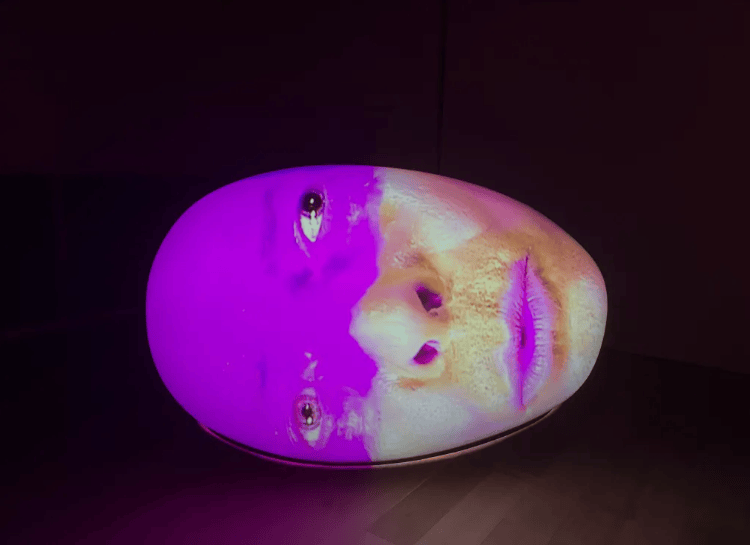
The Tokyo Node project prompted a return to the piece, and the installation is among the strongest moments for Japanese audiences. Bowie wore Yamamoto Kansai’s costumes in the 1970s, spent time in Kyoto, became passionate about Kabuki, appeared in sake commercials, and formed a friendship with Ryuichi Sakamoto — the list goes on. The apparatus recalls Anthony Minghella’s filmed version of Samuel Beckett’s Play, in which Alan Rickman recites his lines while trapped inside an enormous urn. Empty projects Bowie’s face onto four egg-shaped structures; they converse, ignore one another, say nothing, then suddenly raise their voices. Bowie once again delivers an unforgettable performance, shot in a New York artist’s studio, allowing us to grasp the distance traveled since that filmed portrait of Bowie by Andy Warhol at the Factory in the early 1970s. Older visitors held an almost reverent bearing in this room, and the title Empty underscores this place now left vacant. Let us dare say that magic passed through that space.
Heaven + Earth est née d’une découverte fortuite en ligne où Sanborn croisa le travail de Waterhouse.
Un ouvrage collectif consacré à Heaven + Earth paraît aux éditions Silvana Editoriale . Cet entretien annonce celui qui s’y trouve.
— Comment cette rencontre entre vous a-t-elle abouti à l’idée de travailler ensemble sur un projet ?
IW : Je connaissais le travail de John depuis mes débuts dans l’art vidéo — j’en étais une grande admiratrice, je le montrais à l’université où j’ai enseigné quelques années, et je ne cessais de m’émerveiller devant ses découvertes sur l’image et tout ce qu’il a inventé — des choses dont nous, les VJs, nous servons encore aujourd’hui. Ce fut un choc quand il m’a… contactée sur les réseaux sociaux. J’ai dû vérifier que c’était bien lui, son compte, tellement je n’arrivais pas à y croire. La collaboration, au-delà de l’enthousiasme et de l’excitation qu’elle a suscités, avait quelque chose de plus qu’un choix. C’était une nécessité pour moi de faire cette pièce avec lui. Au début, nous ne savions pas que nous allions travailler ensemble. Nous avons discuté pendant presque un an avant de décider de créer quelque chose.
JS : L’un des atouts originels des réseaux sociaux peut se définir par l’accès, la découverte. Il y a des groupes des gens qui partagent ce qu’ils font ou discutent du travail des autres. J’ai vu des extraits du travail d’ionee, la manière dont elle se présentait sur Facebook. Elle avait de toute évidence des compétences qui m’ont incité à la contacter J’ai besoin d’une structure sur laquelle m’appuyer afin de construire et créer des variations, des ruptures. Chez elle, tout est dans le choc d’une chose contre une autre, projeté dans des endroits inattendus comme le Parthénon. J’aime la projection vidéo, elle vous déplace d’une période à une autre, d’un état mental à un autre. Et elle les conçoit avec tout ce que j’aime : les ruptures abruptes dans le temps, dans la texture. Nous avons commencé à échanger — quelques emails à l’époque de l’exposition ZKM en 2022. Puis je me trouvais à la Pudil Foundation à Praha, qui avait acquis mon installation V+M et qu’ils allaient montrer en 2024. J’y suis passé un jour ou deux, dans le grand espace d’exposition avec ces projections du sol au plafond. La Kunsthalle avait réalisé un remarquable travail de reconstitution du projet d’installation original. Pendant ce temps, je travaillais aussi à une version immersive pour Meet à Milan. et j’ai vu ionee entrer dans l’espace, une joyeuse surprise.
— ionee avait déjà un lien avec Castelbuono, où se trouve le Museo Civico qui a commandé cette oeuvre.
JS : Oui, elle s’était mise à me parler de cette chapelle à Castelbuono. Je n’étais même pas sûr si Castelbuono était une ville ou un bâtiment. J’avais certains éléments IA qui attendaient dans des dossiers, prêts pour autre chose. Je ne m’étais pas rendu compte que nous nous étions mis au travail immédiatement, dès nos premiers échanges. L’idée d’une collaboration doit aussi à ce que je faisais avec Sarah Cecilia Bukowski, avec qui je travaille depuis une dizaine d’années sur des pièces de scan photométrique LiDAR. J’avais réalisé un clip pour un compositeur britannique qui intégrait cette technique — quelque chose qui avait à voir avec la laideur. À cause de la manière dont le scanning désassemble le corps humain, j’ai proposé que nous nous en servions dans la chapelle pour explorer d’autres niveaux de transformation. Nous nous sommes donc retrouvés en juin 2024 à scanner, juchés sur des échafaudages — c’était assez dangereux parce que la chapelle est stupéfiante. C’est un reliquaire de Sainte Anne ; le crâne s’y trouve, visible si l’on monte sur l’autel, ce que j’ai fait. Nous avons également scanné trente-cinq figurants. Nous pouvions concevoir rapidement comment cela ça allait être complémentaire aux figures grotesques qui s’y trouvent, venues du baroque. L’avantage du scan photométrique LiDAR, c’est qu’on obtient un modèle réel à l’issue du processus.
— Travailler entre Berlin et Berkeley, après une première période de travail à Palerme — quelle était la méthode ? Vous assigniez-vous des tâches pour ensuite assembler les parties, ou cherchiez-vous une fusion d’esthétiques distinctes ?
JS : En 2025, j’avais une exposition à Francfort, à la Galerie Anita Beckers et je suis allé à Berlin une semaine pour travailler avec ionee. Nous nous sommes installés dans son studio avec nos deux petits laptops côte à côte, pendant cinq jours. Les talents et compétences d’ionee ne se limitent pas au travail de VJ et au mapping ; elle maîtrise également l’animation 3D. Nous savions que nous voulions créer un panorama, tout en tenant compte des colonnes qui se trouvent dans cet espace en Sicile. Nous avions cinq mois pour aboutir. J’étais également à Videoformes à Clermont-Ferrand, en mars 2025, quand je suis tombé vraiment malade. Je n’étais plus du tout moi-même. Mon téléphone a sonné : le Museo m’annonçait qu’il fallait reporter d’un an et j’avoue que j’étais soulagé. D’abord parce que je n’étais pas en forme. Ensuite, parce que nous nous trouvions maintenant devant une véritable à une date d’échéance. ionee est retournée à Castelbuono pour leur festival de rock, où elle a fait du repérage. Nous nous sommes mis à planifier ce qui irait où. Nous sommes différents, mais nous partageons plusieurs élans semblables quant à la transformation, la dislocation, les interruptions, l’idée de mutation, et notre fascination pour ce qui est cyclique : l’amour, la vie. Le titre Heaven + Earth m’est venu à l’esprit parce que l’aspect terrestre — le quotidien, l’ordinaire, les épreuves que nous traversons tous — me semblait pouvoir s’ancrer vraiment dans le concret, tout en s’articulant avec les scans fragmentés des visages avant que l’IA ne les altèrent. ionee s’est mise à fabriquer des éléments à partir de la chapelle, et le processus s’est imposé de façon naturelle : je fais la terre, tu fais le ciel. J’ai commencé à comprendre qu’il pouvait y avoir une écriture qui convenait à ce principe. Dans mon travail, je délibère, je traite, je revois. Je crée vingt images afin d’en sélectionner une. ionee, c’est tout le contraire. C’est le temps réel. C’est l’impulsion du moment, un organisme vivant que je monte. Une bête que je chevauche. J’ai commencé à réfléchir pour que nous puissions croiser ces choses et éviter de nous en tenir à une seule zone par artiste. Le bénéfice dans la collaboration, c’est lorsqu’elle produit quelque chose et que je me dis : mon Dieu, c’est absolument génial.
Elle a commencé à faire du glitching sur ces scans somptueux de la chapelle. Le glitch, c’est la clé. Nous sommes des créatures nées du dégât et du glitch — des fautes, des failles, des erreurs que nous commettons et de ce que nous en apprenons. L’idée que ça ne s’arrête pas quand le corps s’arrête. Le paradis aussi est détraqué. Nous avons donc toute une section consacrée au glitch. ionee a également amené cette idée d’inclure le mapping d’une grande sculpture d’une tête, ce qui m’a d’abord laissé perplexe. Mais c’est là que fusionnent le ciel et la terre. Elle était retournée à Castelbuono pendant l’été 2025 pour faire des scans photométriques LiDAR de la salle entière. Elle a commencé à animer ces vues intérieures. Et l’une des caractéristiques du LiDAR photométrique, c’est qu’il saisit ce qu’il voit, mais il reconstruit aussi ce qui se trouve derrière la surface. Si on fait pivoter la capture, on obtient ces petites vrilles de maçonnerie et de mortier qui n’existent pas vraiment. Quand elle me les a envoyés, j’ai dit : mon Dieu. Oui. C’est ça.
— Vous avez développé un processus très organique d’échange d’idées. John a une longue histoire de collaborations. Pour vous, ionee, est-ce une constante de votre pratique ?
IW : Oui, j’ai collaboré tout au long de ma carrière, parce que je fais des performances visuelles en direct pour des artistes et des groupes de musique. J’essaie de mettre en images ce qu’est la musique. J’ai travaillé dans des genres très différents, de la musique classique au rock. J’ai travaillé avec Desmond Child pendant de nombreuses années, ainsi qu’avec d’autres groupes . La collaboration fait partie intégrante de mon travail. Et je pense vraiment que quelque chose de très particulier se produit dans la création collective — cela va au-delà de ce qu’un seul esprit peut faire. Cette collaboration a été très particulière pour moi, notamment parce que le temps qu’elle a pris nous a donné la possibilité d’expérimenter plusieurs techniques. Les technologies ont tellement évolué en deux ans; ce fut un processus profond et intense.
— Parlons de l’usage de l’IA. Quel rôle a-t-elle joué et qu’a-t-elle apporté à votre logique d’images composite ?
JS : En 2025, j’ai réalisé un projet appelé Ars Moriendi, une œuvre en réalité augmentée mettant en scène deux fantômes. J’ai travaillé avec Sarah Cecilia Bukowski et Lali Wilde. Je crois profondément au divin féminin— c’est un thème présent dans plusieurs de mes œuvres. Écrire seul une pièce sur deux fantômes féminins me semblait absurde. Je leur ai donc demandé de participer à l’écriture. Comme elles sont toutes deux des performeuses, elles étaient aussi devant la caméra.Pour en faire des fantômes, j’ai utilisé l’IA. J’ai beaucoup expérimenté pour y arriver, sur plusieurs plateformes différentes. L’IA me permet de prendre une vidéo de source, un prompt image et deux prompts texte. Je partais des scans photométriques LiDAR, avec un prompt image et deux séries de prompts texte. Et on peut régler d’autres variables pour la densité et l’articulation. Je commence par ces captures d’individus par scan photométrique LiDAR. Ce qui est merveilleux dans ce processus, c’est son caractère très itératif. Je produisais une vingtaine de variations différentes. Puis terminer par l’ajout d’animations de fond. ionee m’a demandé de prendre des matériaux qu’elle avait générés et de commencer à les articuler. Le panorama qu’elle avait créé était magnifique. C’est là où se croisent la part sentimentale des gens, le quotidien, et une sorte de sorcellerie et d’alchimie de l’IA.
IW: Je voudrais préciser que nous avons utilisé l’IA comme outil de transformation, et non comme outil génératif. C’est la part du travail qui consiste à expérimenter avec de nombreuses IA, pas seulement une ou deux. Nous les avons collectionné et assemblé. Je crois que ça montre vraiment comment l’IA est en quelque sorte une mémoire visuelle collective de l’humanité — un peu ce que Jung disait des symboles.
— Fort de l’expérience et des années de pratique que vous avez derrière vous, en travaillant avec ces outils dans de telles collaborations, avez-vous eu l’impression d’inventer quelque chose qui remette en question non seulement le médium lui-même, mais qui sème les graines d’une nouvelle ontologie pour les installations ?
IW : Mon sentiment personnel, c’est que nous touchons à l’inconscient collectif. Que nous puisons dans tout ce qui existe déjà pour le transformer.
JS : Mais il y a un maître qui a entraîné ces machines. Il y a une part d’invention, même si ça n’a rien à voir avec Nam June Paik posant un grand aimant sur un téléviseur pour intervenir sur les balayages électroniques et appelant ça art vidéo. Peu de choses ont changé pour moi depuis les premiers jours du stockage d’images numériques.
photos courtesy of John Sanborn
— Je me demandais aussi si Heaven + Earth cherche à introduire l’IA dans le champ du spirituel.
IW : Oui, c’est un enjeu très profond. Quand je vois ce qu’on a fait et ce que John a réalisé en fusionnant l’univers avec les statues de la chapelle, j’éprouve une impression d’élévation. Et je sens que nous avons touché au sublime pendant ce travail.
JS : On veut y voir davantage — la possibilité de l’expérience, de rencontrer quelque chose qui nous dépasse. Nous sommes tous les deux d’origines catholique. Mais nous ne pratiquons pas. Je pense cependant que le changement, la transformation est au cœur de cette pièce. Ayant écrit ma propre religion (1), la notion de foi — à la fois comme quelque chose d’utilisé et d’abusé — n’est pas loin de mon sentiment que l’humanité est démunie de toute valeur morale, mais c’est tout ce qu’on a, et on doit faire avec ce qu’on a. Et ce qu’on a, ce sont ces habitants de Castelbuono qui ont dit : oui, scannez-moi. C’est une invitation que je ne prends pas à la légère. Parce que quand on fait la promesse d’essayer d’atteindre un objectif et qu’on demande à d’autres artistes, modèles, participants de nous aider à y parvenir, c’est un acte de foi. Et la foi qui a présidé à la création de ces sculptures était probablement dogmatique. Mais quand on voit l’œuvre elle-même, c’est complètement fou.
— Cette pièce est-elle imprégnée d’une part de mysticisme ?
IW : Je voulais ajouter qu’on utilise aussi ces nouvelles technologies pour exprimer un sens de la mort, pour maintenir la contemplation dans un espace historiquement conçu pour la croyance — et pour atteindre la sensation d’émerveillement. L’IA non pas comme forme de spiritualité, mais comme démonstration de comment la création humaine, par des outils différents, peut y parvenir.
JS : Exactement. C’est pour ça que j’ai transformé les visages en briques, en plantes, en notes de musique. Cette idée qu’on essaie de comprendre ce qui se passe, et que l’art est notre meilleure tentative de voir l’âme.
— Le manierismo, formellement évoqué dans Heaven + Earth, était d’une certaine manière déjà présent dans les premières œuvres numériques de la fin des années 80, notamment ces reproductions de tableaux en images de synthèse … L’IA fournirait-elle simplement une nouvelle itération d’un style baroque ?
JS : Pour revenir au point d’ionee, on ne fait pas du génératif. Tout est fondé sur quelque chose. Tout est transmutation ou transfiguration de l’existence. Je pense que la peur de l’IA tient à cette large part d’inconnu. Il y a des questions morales, esthétiques, pratiques auxquelles on n’a pas encore répondu. Mais les êtres humains aiment inventer puis gérer les conséquences. Qui aurait imaginé ce que la télévision allait devenir ? Maintenant, avec l’IA, si vous voulez savoir où je place ma foi, je la place en ionee, et dans ma capacité à travailler avec un outil. Y aura-t-il une église de l’IA ? Absolument.
— Heaven + Earth cherche-t-elle à montrer des figures qui affrontent et composent avec le baroque négatif de la chapelle ?
JS : Je ne pense pas qu’on soit si délibérés. Notre voyage commence là où la chapelle s’arrête. Les distorsions et les transformations sont pour nous les questions intérieures. La raison pour laquelle je fais des scans photométriques LiDAR, c’est que je décompose la technologie pour créer des instances qui mélangent le beau et l’étrange. Parce que c’est ce qu’on est en tant qu’êtres humains. On peut être ravissant et poli, et on peut aussi être de vrais cons. On aimerait que nos meilleures qualités nous mènent au paradis, mais si on ne croit pas vraiment à l’existence d’un paradis, on peut aller dans un bon parking quelque part, se garer et se préparer pour la réincarnation. Dans cette chapelle précieuse, dans cette petite ville, on a le cas d’une oeuvre d’art qui transcende le pratique, l’utile, l’aspect commercial. Parce qu’on entre et il y a une histoire, mais on ne lit pas l’histoire. Ce qu’on lit, c’est cette déclaration. Et la déclaration pose plus de questions qu’elle n’apporte de réponses, parce que c’est ça la foi.
IW : Oui, j’ai aussi senti qu’en regardant avec un regard contemporain, ce qui était peut-être perçu avant comme sombre ou effrayant est maintenant perçu comme beau et bizarre. Je crois que c’est aussi une chose qui nous est propre, à John et moi : il y a cette part d’émerveillement partout autour de nous. Et c’est à nous, en tant qu’artistes, de révéler ce qu’on peut, à notre manière, mais aussi d’amener les gens à tout regarder différemment. Il y a un continuum. Il n’y a pas une seule déclaration, une seule perspective, un seul point de vue. Il y a votre interprétation. Et nous sommes profondément attachés à l’interprétation.
photos courtesy of John Sanborn
photos courtesy of John Sanborn
photos courtesy of John Sanborn
— Comment espérez-vous que cette pièce résonne, auprès du public et de vos pairs ?
IW : Je crois qu’on veut repousser les limites de la perception pour produire cette intensité et cette révélation. Aujourd’hui, on est entourés d’un excès d’images, de contenus et d’informations, mais on espère pouvoir capter l’attention des gens et les toucher. Je crois que repousser les limites, c’est quelque chose qu’on aime tous les deux faire.
JS : Si mon propre parcours peut servir de modèle, on finira ce travail, le livre sortira. Il sera vu par un petit groupe de personnes, évidemment beaucoup plus pour les habitants de Castelbuono. Si mon histoire pointe vers ce qui viendra ensuite, elle sera prodigieusement mal comprise. V+M en est un bon exemple. À sa première à Videoformes, j’entendais : ça ressemble à un défilé de mode, c’est comme MTV… Une décennie plus tard, la pièce a été entièrement réévaluée. Ce que j’espère, c’est qu’on puisse, pour des événements comme MEET, la transformer en pièce immersive, parce que tout dans l’œuvre est plus grand que nature (2). Je pense que les trois phases de l’œuvre peuvent s’adapter à d’autres lieux. Cette exposition-ci est vraiment intégrée au Museo, à Castelbuono. On est dans un site construit au quinzième siècle . Il y a donc une joie à anticiper d’être mal compris. C’est une pièce de media art, sauf que c’est probablement un peu plus que ça.
— Dans l’histoire de l’art vidéo et du media art, il y a des jalons où il a résonné avec le sacré. Tu l’as fait, John, avec V+M dans une église encore plus ancienne à Clermont-Ferrand. Je me souviens aussi de Gary Hill, vers 1990, avec son remarquable Crux. Mais ce que j’ai vu à travers les présentations et les extraits… c’est que cette pièce est simplement infusée de grâce.
JS : On ne cite pas les Écritures. Je crois qu’on cite ce qui nous entoure. J’aime l’idée qu’on l’ait infusée de grâce. Je ne cesse de penser à l’essai que Jean- Paul Fargier a écrit pour le livre du ZKM Collectionneur de Bouilles.. La puissance du visage humain, l’individualité, la communauté, les structures sociales — les gens les plus malveillants du monde peuvent avoir les visages les plus agréables. Je voulais préciser un point, ionee, l’exposition à Praha et celle à Milan étaient la même année, donc on travaille ensemble depuis deux ans. Ce que je veux que les gens comprennent, c’est que sans vraiment se connaître ni savoir ce qu’on allait faire, on a commencé à travailler. Et c’était vraiment jouissif. C’était comme : qu’est-ce qu’on fait ? Pourquoi je monte sur cet échafaudage ?
IW : J’avais très peur des hauteurs tandis que John était prêt à se lancer, mais c’était une structure métallique verticale avec une base en bois très fine. Il y avait un homme extraordinaire qui nous aidait, comme s’il avait toujours été là, qui changeait la hauteur du bois. Pas de corde, pas de harnais. Et ça oscillait légèrement. Alors après une journée entière à faire ça, j’ai miraculeusement surmonté ma peur des hauteurs. Ça a été un processus complexe. Mais en même temps, une expérience vraiment magique.
JS : ionee, je pense souvent que tu as ce très long tissu que tu brodes au fur et à mesure . Moi, je fais des patchworks. Je découpe des morceaux. Le temps est comme un fleuve. On ne peut jamais entrer deux fois dans le même fleuve. ionee commence quelque chose et continue. Moi, je cherche le rythme. Puis il m’est apparu que le lien était immédiat entre nos pratiques. Ce fut une révélation pour moi en termes de traitement et de montage. Tu m’envoies quelque chose qui dure trois minutes. Et je me dis : voilà, ça c’est dix bonnes secondes.
1 — Pour l’installation The Friend, 2022. 2 — La commande donne au Museo Civico l’une des trois éditions de l’œuvre.
S : It’s been a while since there’s been a media art show of this scale in Tokyo. Philippe Parreno had a show at the Watari-um in Tokyo a few years ago, and a larger one after that at the Pola Museum in Kanagawa. There was Bill Viola’s show in 2006 at the Mori Museum, and in your case, I remember a show at the CCA in Kita-Kyushu in 2012, well more a selection of single- channel works from the eighties, each one with its own monitor set on the floor and a small bench to sit on… But this show…it’s a fabulous exhibition. I genuinely wasn’t expecting this, since I’d seen other things in that space at Tokyo Node before. I had some concerns going in. I was honestly blown away by the results. One thing I learned only at the very end was that the space is actually twice the size of the Mori Museum space.
TO: Yeah — I didn’t fully register that until I was ¾ of the way through the set up.
S: How did this come together? I remember three years ago you gave a talk at the Mori. You’re represented in Tokyo by Scai the Bathhouse, one of the best galleries. Did it take a long time for the show to happen?
TO: No, actually — it came together quite quickly. When I did the exhibition in Kaohsiung Taiwan, Black Box, during COVID, Yulin Lee the director and Alice Nien-Pu Ko, the curator, and I — we’d really hoped to tour it, and we reached out to the Mori. They were interested, and we had some good meetings — the director Mami Kataoka came to my space in New York, we had a good conversation, and then I did a talk at the Mori, you were there. Then I had an exhibition at SCAI the bathhouse which was the first in Tokyo in a long time and participated in the group show Ghost in Maebashi. In the mean time, Mori had a gap in their program, and saw the advantage of having all this work in Japan and that’s really how everything works these days — if you happen to be in the right place when someone has a gap. As part of the new chaos institutions and artists have to figure out ways of making work on site rather than costly shipping–because in fact that may make difference between doing an exhibition or not. That’s how the last couple of exhibitions have come together for me, honestly. Alice Nien-Pu Ko already knew the work well, and we’d been collaborating on the Remote-Viewing installation for a group exhibition she curated in Taipei, so it made sense for her to co- curate the Tokyo show with Reiko Tsubaki. Once that was set, we really went to work — Alice brought deep knowledge of the recent work and some of the older pieces, Reiko brought her own expertise, and the three of us worked things out together over probably six months, laying out the show. I built models in my studio in New York, walked through the actual space in Tokyo, saw a previous exhibition there — some kind of science show for kids. The Spaces designed by Shohei Shigematsu are surprisingly hard to define in the abstract — building 3D models in my studio , walking the space myself, working with both curators, we arrived at the final arrangement. My main aim was to make sure it was a balance of older works that have not been seen and newer work was well represented.
S: I’ve mentioned before that shows of this scale, devoted to international media and video art, have been few and far between in Tokyo in recent years. It also speaks to something I raised earlier — of your generation, you’re one of the few whose work has consistently moved with the times, with no real dead periods, and one of those who also secured serious gallery representation. For a Tokyo audience, though, you were very much a discovery. The show, going from the tapes of the eighties up through the newest commissioned piece, really let the audience see the evolution —you’re an installation artist, a video maker, a writer, a performer, a collaborator working with extraordinary musicians out of the New York scene, and you’re now using AI in some pieces. It covers all of that. As all of these evolved over forty years of practice— which one has been especially meaningful to you?
TO: That’s a great question. I’d say image-making in general. You mentioned the early tapes — there was The Loner, which won a prize in Japan around 1980 or ’81; it’s gotten a little lost in the shuffle of this show. But going from those early tapes to how I make images now has been a fantastic journey, because the technology itself has changed so much —how animation gets produced has changed so much. That’s really evolved the most, because I’ve made it something of a mission to attack whatever new tool comes along and see what I can do with it, from the earliest Porta-Pak tapes of the seventies through the internet to AI now. The layering, the digital editing — it’s remarkable. You probably know the earliest editing technique involved two reel-to-reel decks and a piece of paper stuck into one of the machines; you’d rewind with the paper in place, hit play manually with both hands, and hit the edit button the instant the paper dropped out. That’s how reel-to-reel editing worked. Now, with Premiere, I can sync twenty tracks, layer endlessly, build things up, even generate AI animation within it. It’s phenomenal, and it’s changed how I think about content structures and narrative too — the technology and the thinking evolve together, back and forth, and that’s been a wonderful exploration.
Writing, Narrative, and Language for a Tokyo Audience
S: Seeing the show, there were pieces I’d missed over the years — I’d read about them, seen photographs, but never encountered them directly. What stayed with me most, and is still present throughout, is the craft of writing, the storytelling that runs through the show. I wondered— did you and the curators ever worry that a Japanese audience might get lost somewhere in the language?
TO: The language question was real. Purposefully, some of the newer pieces — the ones that ended up premiering in Asia, like the Star piece and the commission Chimera, the final piece in the show — have almost no language at all, though there are scripts waiting to be worked back in eventually. Around eight or nine years ago I did a large commission for my friends Jill and Peter Kraus, who have a wonderful outdoor sculpture park on their property in upstate New York, close friends of mine who are really interested in moving image and outdoor work. It turned out they didn’t want language or sound in the piece at all because of the way sound carried through the landscape and that was a great moment for me — a chance to step back and ask why I was automatically reaching for writing or text in every piece. Why not go back to the image itself?
It took a few years to rethink that, and that reworking of the role of text has kept evolving with each piece since. I always try to write specifically for the piece at hand, even if I end up repeating myself in certain ways, trying to bring a fresh approach each time. The silence, when I finally embraced it, was a genuinely great moment for me — it made me rethink how information gets built into an image at all. This lead to a new path of visuals informed by new trends on social media graffiti to express conspiracy and associative thought. I was happy to bring some ofthat into the Tokyo Node pieces, and into Asia generally — the Star piece actually began in the Remote-Viewing show in Taiwan and then traveled here, workshopped along the way. I did wonder about people losing the language, or finding new meaning in it, or misreading it. But that’s the nature of the beast. Imponderable is probably the piece with the most text and subtitles, and I’m honestly not sure how that worked for a Japanese audience. That is a linear narrative for as close as I get to one a feature film with a true story but it’s also an art work. Sometimes people just switch the language off entirely, which is a valid part of the experience — they might just want to look at the image, or catch one fragment and drift off into it, forgetting the rest of what’s being said. The pieces can have an almost organic quality that way like walking through a crowd, or overhearing a conversation. I’m happy to let the language peel away at different points. in the case of imponderable, there are many layers of language outside of the 5D film itself. There is the archive of artifacts related to the characters and themes as well as a fully Japanese flow chart, outlining characters, concepts, and historic events. There are so many ways for the Japanese audience to interact. Including the full script printed in the back of the catalog.
David Bowie
S: There’s one thing I want to rave about — the Bowie-Branca piece, Empty.
TO: It’s a quadraphonic piece that was shot in 1999 and 2000, a collaboration between Glenn Branca for the music, David Bowie for the performance, and me doing the text and installation. Glenn recorded the music, David came and recorded the text and did his performances for the camera , and it was never finished — only a short excerpt was ever released, semi-unintentionally bootlegged, which I put into Electronic Arts Intermix’s collection for a while. It was meant to be projected onto four monolithic egg-shaped heads, with viewers wandering the room and the music swirling around them, an endless kind of recombining poem.
I first met David in 1996; he wanted to use my work in his live show at Madison Square Garden for his fiftieth anniversary , which he did, and I traded him a performance for it — I didn’t want any money, just an afternoon to shoot something it was such a thrill as he was an idol for me. I knew every note and word of his songs. I always thought, well I’ll never see him again but we became friends. Lucky for me we worked on a few things together and he ended up performing in a few works over the years which was wonderful and generous — what a character, this kind of shapeshifter, multiple-personality figure, in the best sense. I always thought of him as a harbinger of the internet, in the way It facilitated multiple-personality disorder. if you look at the history of MPD going back to Pierre Janet in France, He isolated to coexisting minds in one patient and later the book and film The Three Faces of Eve, from 1957 — a woman with three or four personalities, an obvious tale of a woman emancipating herself from a frustrating life by becoming someone else — anticipates something the internet would later make literal. By the time I met David, it was right before the internet, a kind of utopian tech moment, and I really felt that media’s ability to fragment the self also let you recombine the self in new formations, with all the world’s information leveled onto a single plane for anyone to sample. He was a symbol of volition. It was fantastic to have the chance to work with him.
photo : Tokyo Node
photo : Yuya Furukawa
S: I saw the show twice, and both times I watched people genuinely moved by the Bowie piece, staying with it. Writing to you afterward, I described it as almost Beckett-like: the cuts into something wholly abstract, returning to the face, dissolving it, this very painterly abstraction, then returning to him again, his face exploding like a constellation, like a nova. All this heightening his extraordinary voice performance — it felt like fireworks.
TO: — thank you, that’s a beautiful way to describe it. There was a real evolution in how it came together. There were no good opportunities to show the work and I let it drift in time knowing that one would come along. Then David’s death came as a shock too, sudden, and stunned everyone. Sadly Glenn died recently — there’d been a miscommunication and I hadn’t known how sick he was; I’d actually turned down one earlier chance to show Empty in New York while he was still alive.
I don’t have many projects like this one, hanging unfinished for so long — some artists work on something for twenty years deliberately, but this piece mattered so much to me that I think I procrastinated on it simply because I wasn’t sure how to approach it, how to find the right moment for it, and then to make that moment feel intuitive rather than forced. I had a sense that it was time to finally finish the work: the next venue gets it no matter where that is. japan seemed perfect. Bowie was perfect for the text i was writing then in 1999 as all sorts of things resonated between us —William Burroughs’s cut- up technique, which we talked about quite a bit, and multiple-personality disorder as a media meme (in the philosophical sense) a kind of faux mental illness, a state of flux, that media amplification provoked, something I was already tracing toward the internet, even though the internet barely existed yet when we met. I brought in Glenn Branca too, since I knew he and David admired each other’s work. I was already in touch with Glenn — he was enthusiastic right away. The idea was that he’d compose a quadraphonic soundtrack that could be remixed in different combinations; he handed me a piece of music and told me to go ahead and remix it however I wanted. David came in to record the video — four variations of face painting, and four separate performances of the text, which overlap somewhat, all done under the working title Empty, or Empty Blue. Since this was around thirty years ago, I had to go back and really reread the text to remember what I’d actually intended. Going back into the footage, I was a little nervous, because there were resolution problems — I’d shot it on the first digital cameras available, I thought at the time was a very high-resolution digital camera, but it turned out to be quite low-res; The difference between analog and digital resolution standards hadn’t been defined yet. This issue was probably part of why I kept putting the project off. Now, I was able to solve that with software that simply didn’t exist even a few years ago — there’s a real serendipity to the project having waited this long, since I couldn’t have finished it properly any earlier. Even though I was haunted by the loss of my friends. I listened to David’s four performances over and over.
I don’t actually remember directing him much at all, though there’s some behind-the-scenes audio and footage I’ll share with you sometime, where he riffs on my name at one point — I’d asked him whether it was hard to keep his face still, locked into the frame, and mentioned that a friend of mine had found the same setup really disturbing to perform in. David joked that I was apparently subliminally into torturing my performers, and went off riffing on « Tony hours » for a while. « tony Owwwrsler. » The four performances had his face painted in opposing primary colors, red and green — a strange, almost hellishly Christmas-colored effect — plus a more gestural, almost Joker-like version, and a fourth using an in-camera negative effect he was quite taken with. The script speaks of colors — blue, for me, has always been tied to film, television, that mnemonic glow of the tube, or the projector. But the underlying text is really about the transition that happens through any kind of mediation, through the lens itself. I’d been writing the thematic timeline around that same period — the one that starts with the camera obscura — and eye imagery and projection tied back to that, a theme that’s run through my whole life, thinking about the space of mimetic play against reality. The text I wrote for David I imagined as a character being pulled through the lens into a virtual space, an inversion happening within light cones — something like two pyramid shapes in space, a dark region and a light region, above and below, as above, so below. As we live more in immediate world, we all have a visceral sense of this transformation with surveillance and computers. There’s an implicit subtext equating David himself with the character, since he spent more time in front of a lens than almost anyone, using it deliberately to manipulate audiences and, in a way, to transform his own persona. The characters in the text move from flesh into light, from physical space into virtual space — a contemplation, as best I could manage at the time, that also draws on the cultural connection between the phantasmagoria, magic, and the apparatus of the camera obscura.
That’s essentially how the piece evolved. Unlocking the text again was the first job — like reconstructing what I’d meant thirty years earlier, hoping I wouldn’t botch the chance I’d had to work with David and Glenn. To honor their memory and commitment to experimentation. Working on it now carried real weight, because both of these titanic figures, Glenn and David, are gone, and they have nothing left to say about it — I really wanted this to be a tribute to their creativity. Once reconnected to the text , the next step was timing. Originally I imagined the four performances recombining somewhat randomly, but I quickly realized it would take production of a computer team that wouldn’t work here — without it would just become cacophony, impossible to follow.
So instead I tracked it out manually with all four faces meticulously synchronized and worked through the text almost like an elaborate card game — Premiere’s editing tools make that kind of work far easier than it would have been even five years ago. I found the pacing and rhythm — one character, the green one, is aggressive, fast, almost yelling; another, split top to bottom, is much more passive. It was wonderful discovering how distinctly David had delivered these four different takes on the same text. They end up talking to each other, sometimes saying the same thing at once, sometimes simply complementing one another, moving from one character to the next. This could change if I show the work again some place else but for this situation I mapped out the timing until it felt right, while building in blank spaces to give it room to breathe — thinking about how that would work spatially, bringing David’s face back in different ways: sped up, slowed down, run through AI with different prompts, with varying success, and at times getting genuinely spooked about whether to use any of that AI material at all but in the end it’s very subliminal hallucinogenic which I love. Out of the text came the idea of going through the lens, which meant I had to find a way to depict light itself — since David keeps turning into light in the piece — so I worked with lens flares, abstraction, colorization, effects, eventually incorporating stock footage alongside animated footage, AI material, manipulated and colorized versions of David, and references to psychedelia, even a bit of 3D modeling — since there’s a running media reference throughout the piece, and you can only gesture at that verbally so far in a visual medium.
I came close to putting fireworks in at one point, and didn’t, though there are a couple of explosions. One discovery I made near the end: at several points in the text, he says, “May I have complete silence? » I realized that was a natural place for the piece itself to go silent and reset. Then the cacophony starts again. There’s also a moment where one character takes over all four faces before positioning the four egg-shaped sculptures/projection screens — and I thought, what if that had its own sound effect? I offset the faces six or eight frames apart and gave them a live delay effect, so you’re hearing an actual audio delay happening quadraphonically It’s a very simple trick, but I hadn’t quite seen it done that way before, and it felt fitting given David’s history as a musician — it has this rock- anthem quality to it, but it’s also literally concrete, a real delay you experience across four channels. A little audio magic. That’s also a tribute to editing in Premiere, honestly — being able to nudge a clip three, five, six, eight frames and get that effect.That’s how the piece finally came together.
S: It’s wonderful to hear all of that especially for the Japan show, because David is genuinely revered here — his relationship with Japan runs deep. People of a certain generation here adore him.
TO: Bowie fans will find a special dimension of his work here, and his commitment to art. They can become immersed. Play with shadows and selfies. one thing I hadn’t fully accounted for was how physical the piece is to move through; you really have to walk around it, more than I’d expected. Did you notice people moving through it that way?
S: I had fun with it — I was moving around constantly myself, but I noticed Japanese audiences being almost too respectful, staying near the entrance, watching from a distance rather than stepping right in front ofit. I appreciated that, actually, it was very moving. And Glenn Branca’s music, the way it resonates with the visuals, is just epic — that particular wall of sound is so intense,and it really works. It’s remarkable how it all resonates together. In a similar vein, I hadn’t seen Imponderable since the LUMA show in 2015, and watching it again was both moving and genuinely stimulating. And of course, JG Thirlwell’s music throughout points to another great collaboration. The Frankenstein song is magical.
TO: Yeah, Jim did a great job on that. The Frankenstein song is a strange story — I wrote that melody myself, sang it into a cassette recorder half-asleep one morning, after essentially dreaming the song and waking up with the text already written. I sang it, in my own spastic way, for Jim Fletcher, the performer, not really knowing what he was capable of. I knew he was a great performer, but he just said, give me ten minutes, let me play it back a couple of times. He memorized the whole thing and sang it, and then Jim Thirlwell built the backing track around it. I’m glad you loved that — honestly, I cried when Jim sang it, because it was one of the last things we shot for the film, and it was incredible that he was able to make it that moving. Thirlwell is a master of so many genres — he’s had a substantial career in television too, cartoons, soundtracks generally — so he knew exactly what to do, and he raised the level of the whole film because of it. I’m really glad to hear those reactions, from you, from the Tokyo visitors to the show. It’s great that this could finally happen!
Photo : Tokyo Node.
cet entretien sera prochainement disponible en français
Conversation with Alice Nien-Pu Ko
Alice Nien-pu Ko is a curator and writer based in New York whose practice explores how time-based media, contemporary myth, and disrupted archives shape historical memory, perception, and perspective of human consciousness through the possibility of contemporary art.
She offers here a distinct generational perspective on the work of Tony Oursler. As my discussion above with the artist underscores, the use of technology, its evolution, have been consistent markers throughout his practice, and one would argue that his peers from were also engaged in conceptual strategies. Hal Foster did observe that Oursler also belonged to a group of artists who came out of CalArts. There may have been a time when video and media art went along with being legitimized by writers within the spheres of contemporary art. But the longevity of Tony Oursler’s career, however, has demonstrated an accumulation of histories to which he belonged, turning them into material for his considerable archival enterprise.
S: How did you first discover Tony’s work?
A : – I first encountered Tony’s work in 2006, in New Media Collection 1965–2005, an exhibition from the Centre Pompidou presented at the Taipei Fine Arts Museum. Curated by Christine Van Assche, then Chief Curator of New Media at the Centre Pompidou, the exhibition brought together artists working with video and time-based media, including Vito Acconci, Peter Campus, Isaac Julien, and Pierre Huyghe. I had the pleasure of meeting Christine some years later. In the exhibition, Tony’s work was Switch. At the time, what fascinated me was the way the projected face seemed to detach itself from the screen and inhabit architectural space. It wasn’t simply a video installation; it felt like a psychological presence. Years later, in Tony’s retrospective Black Box at the Kaohsiung Museum of Fine Arts, I found myself returning to that early encounter. I selected Philosophers from Switch and installed it in a museum corridor, where the projected characters engage in an elliptical and often absurd discussion about logic. The transitional space of the hallway reinforced one of Tony’s enduring concerns: how projected images transform architecture into a psychological environment rather than simply a site for display. In Tokyo Node, you could see similar earlier works such as F/X Plotter, first installed on the main staircase of documenta IX in 1992. As one of his earliest sculptural dummy works, it marks a pivotal moment in his practice. Another work that has remained especially important to me is The Influence Machine. When we presented it in Taiwan in 2021, it was, to my knowledge, one of the first opportunities for audiences in Asia to experience it. As Tony’s first large-scale outdoor projection installation, it represented another major expansion of his spatial thinking. By bringing together the intertwined histories of Spiritualism and communication technologies, the work demonstrates something that continues to define his practice.
S : Were you looking at it through the prism of video art history and the generation he belongs to (Gary Hill, Bill Viola, John Sanborn, Dara Birnbaum), or through a larger installation practice in contemporary art?
A : – I was looking at Tony’s work through the broader history of installation and post-studio practice in contemporary art, rather than primarily through the history of video art. The environment he encountered at CalArts was developing new ways of thinking about artistic practice in which material, form, language, process, and content were continuously exchanged and tested across disciplinary boundaries. Under the mentorship of John Baldessari, who famously challenged medium specificity in favor of conceptual inquiry, Tony was encouraged to think beyond the conventions of any single medium. Figures such as Douglas Huebler, Laurie Anderson, Susan Rothenberg, Julia Heyward, David Askevold, and Jonathan Borofsky further contributed to a culture grounded in experimentation and critical engagement with systems of representation.
For Tony, the importance of video did not lie in the technology itself. Its convergence with conceptual strategies provided a methodological framework for investigating the psychic, spectral, and sociopolitical dimensions of representation. Instead of committing to a category of media art organized around particular technological forms, he took technology as a conceptual instrument: a means of examining mediated subjectivity, subcultures, fiction, language, and unstable embodiment. This approach developed in dialogue with peer artists such as Mike Kelley, Jim Shaw, and Ericka Beckman, whose practices likewise moved across sculpture, performance, film, installation, and narrative.
I agree with what Hal Foster suggests: Tony belongs to a generation of CalArts artists including Mike Kelley, Jim Shaw, and John Miller who turned away from the semiotic concerns of the Pictures Generation and toward an exploratory engagement with subcultures, vernacular knowledge, and the historical infrastructures of perception. Their work neither adopts the detached critique of mass media associated with the Pictures artists nor the documentary commitments of later ethnographic or archival practices. Instead, it mobilizes collections, narratives, and cultural residues as speculative instruments for probing the psychic, technological, and ideological systems that shape contemporary subjectivity. This marks Oursler’s singular contribution: redefining the moving image as a material, spatial, and psychological presence that inhabits objects, architecture, voices, and bodies, creating an immersive perceptual environment.
S : When you did your first important exhibition of his work, which themes and concepts in his work were you examining, and what was your reading of them (were you coming from any particular theoretical framework?)
A : The exhibition was titled Black Box, a concept that emerged from both Tony’s artistic trajectory and my broader research into media theory, psychology, and cybernetics. One of its starting points was a conversation between him and Mike Kelley in An Endless Script (1999), in which Tony reflected on L7–L5 (1984), first presented at The Kitchen. Unlike artists such as Nam June Paik, Shigeko Kubota, and Wolf Vostell, who sculpted with the monitor itself, Oursler treated projected light as his sculptural medium, separating the image from the screen by reflecting it onto glass. As he described it, he became interested in « the space after the light leaves the monitor; where life begins, and the machine ends. » That sentence became the conceptual anchor for the exhibition.
He later described these reflections as becoming « trapped » within sculptural form, allowing the disembodied image to be recontextualized within the installation. For me, this marked a fundamental shift in his practice. The moving image was no longer confined to the screen but entered architectural space as a psychological and perceptual presence.
This transition also resonated with Tony’s longstanding engagement with the history of the camera obscura, where projected images occupy an ambiguous territory between scientific apparatus, optical illusion, and embodied experience. The retrospective therefore traced how he consistently returned to these pre-cinematic and optical histories throughout his career—not out of historical nostalgia, but to examine how technologies of vision continually shape consciousness, perception, and subjectivity.
That historical trajectory naturally led to the exhibition’s central concept: the black box. Originating in engineering and later developed through cybernetics, systems theory, cognitive science, and psychology, the black box describes a system that can be understood through its inputs and outputs while its internal mechanisms remain only partially accessible. It became an epistemological framework. His installations continually expose the limits of what can be observed or explained, whether in relation to media technologies, perception, psychology, or the mind itself. We may witness behavior, hear voices, or even record neural activity, yet the processes through which memory, belief, and subjectivity emerge remain fundamentally opaque.
S: Was the process very different for Tokyo Node, was your co-curator’s perspective very different from yours?
A: Yes, the process was quite different because the two exhibitions had fundamentally different objectives. Black Box was conceived as a retrospective that looked back across Tony’s artistic trajectory. The selection intentionally brought together key works from different periods to examine how his thinking evolved over decades and to identify the recurring questions that have remained central to his practice. Looking back, the timing of Black Box also shaped the process in unexpected ways. While planning the exhibition at the end of 2019, just before the outbreak of COVID-19. As museums around the world paused their programs, the project was inevitably delayed. In retrospect, I became grateful for that extended period because it allowed much deeper conversations with Tony and the studio. I had the opportunity to spend time with early archives, revisit lesser-known works, and better understand the longer arc of his thinking. The catalog became an extension of that research, bringing together essays by longtime collaborators and writers including Constance DeJong, Tony Conrad, Elizabeth Janus, and Raymond Bellour, each of whom sheds light on different dimensions of his practice.
By contrast, Tech/Gnosis: Magic, Media, Art at Tokyo Node was less concerned with looking back than with asking how Tony’s work speaks to the present and the future. Rather than presenting a historical survey, the goal is to introduce audiences to the conceptual vision that continues to drive his practice and to show why his work feels increasingly relevant today. The exhibition wasn’t simply about the future works Tony might create; it was about inviting audiences to imagine the kinds of technological, psychological, and cultural futures that his work helps us understand. That different objective naturally led to a very different selection of works.
One aspect of the exhibition that was particularly important to me was how to frame the idea of magic. I felt it was essential to move beyond an understanding of magic as a fascination with the supernatural. Instead, I approached it as a way of examining how systems of belief continue to operate within technologically advanced societies. Throughout Tony’s practice, spiritualism, illusion, psychology, telecommunications, artificial intelligence, and media technologies are not presented as spectacles of the occult. Rather, they become different historical frameworks through which he investigates how images and technologies shape perception, construct meaning, and mediate our understanding of reality.
From that perspective, I aim to develop the exhibition through what I describe as a dual movement of disenchantment and technological enchantment. Modernity has often been understood as a process of disenchantment, in which scientific rationality gradually replaces myth, ritual, and magical thinking. Yet my argument is that Tony’s works indicate that modernity has never fully disenchanted the world. Instead, every technological transformation simultaneously generates new forms of enchantment, projection, and belief. Technologies do not simply extend human perception; they become environments that reorganize consciousness, emotion, and the social imagination.
Tony’s work reveals this process with remarkable clarity. Moving between nineteenth-century optical devices, early telecommunications, television, digital networks, and artificial intelligence, he demonstrates that media are never neutral tools. They generate affect, suggestion, intimacy, paranoia, and collective myth. For me, Tech/Gnosis was ultimately about understanding how technological systems continually reinvent the conditions of enchantment. In this sense, « magic » is not a supernatural phenomenon but a critical framework for understanding the psychological and cultural experience of contemporary media.
S: Even though Tony Is represented by one of the more serious contemporary art galleries in Tokyo, this is the first time he’s had a show on this scale in Japan. For many viewers, this will be the first opportunity to see so much of it. Which piece would you say crystallizes what his work is about in this show?
A : It’s difficult to choose a single work because Tony’s practice has evolved continuously over more than four decades, and each body of work opens onto a different set of questions. But if I had to choose one piece for this exhibition, I would probably say The Imponderable. Not because it summarizes his entire practice, but because I think it offers one of the richest entry points into his way of thinking. Through this work, audiences can begin to understand his longstanding engagement with the history of media, spiritualism, psychology, technologies of belief, and the instability of perception.
One of the reasons I find the work so compelling is his decision to reconstruct the installation through a contemporary adaptation of Pepper’s Ghost. I don’t see this as a nostalgic return to an obsolete theatrical device but as a demonstration of his understanding that media technologies never simply disappear; they persist as cultural structures that continue to shape perception long after their original historical moment. Developed in the mid-nineteenth century, Pepper’s Ghost produced the illusion of transparent figures appearing on stage, emerging at precisely the moment when Spiritualism, photography, and new optical technologies were transforming how people understood reality and the unseen. By reactivating this device today, he creates a dialogue across historical periods, suggesting that every technological revolution also produces new forms of belief and new ways of imagining invisible worlds.
The title itself is equally significant. Imponderable was a term used in eighteenth- and nineteenth-century natural philosophy to describe invisible forces such as electricity, magnetism, light, and heat, the phenomena that could be observed but not weighed or fully explained. What interests me is that Tony uses this historical idea to draw an analogy with our own moment. Just as those invisible forces challenged the scientific understanding of their time, today we are surrounded by equally opaque systems that profoundly shape our lives and beliefs while remaining largely inaccessible to direct perception.
Rather than asking the audience to distinguish truth from illusion, he asks us to consider how images themselves produce belief and how media technologies become instruments through which reality is experienced. Back to what I discussed about the curatorial framework of the exhibition, it shows that Tony is not simply interested in ghosts, illusion, or media history. He is interested in how every new technology reorganizes perception and gives rise to new forms of enchantment. What appears to be a historical installation is, in fact, a remarkably contemporary reflection on the psychological and cultural conditions of living in an age shaped by digital media, artificial intelligence, and increasingly invisible technological systems.