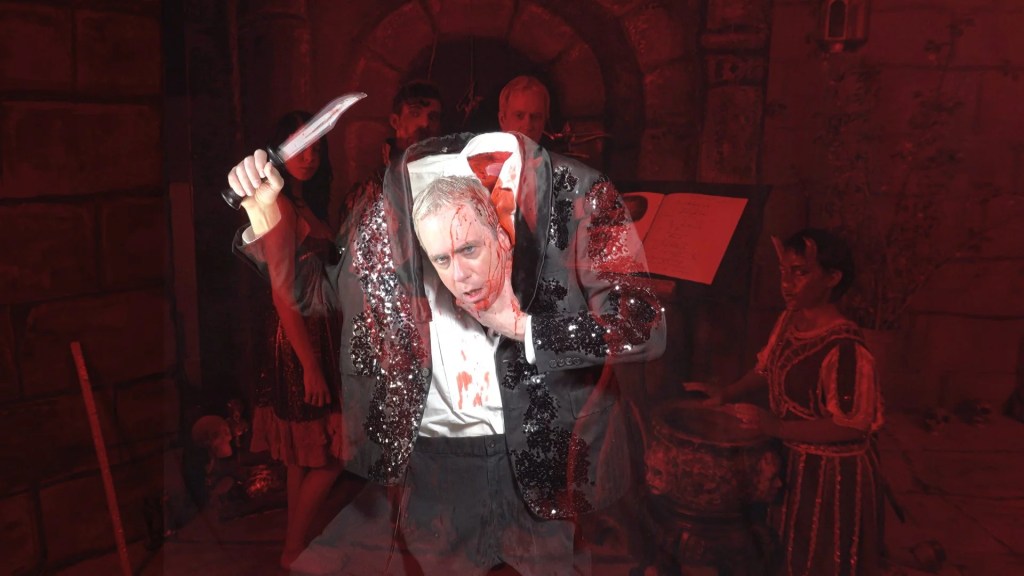
S : It’s been a while since there’s been a media art show of this scale in Tokyo. Philippe Parreno had a show at the Watari-um in Tokyo a few years ago, and a larger one after that at the Pola Museum in Kanagawa. There was Bill Viola’s show in 2006 at the Mori Museum, and in your case, I remember a show at the CCA in Kita-Kyushu in 2012, well more a selection of single- channel works from the eighties, each one with its own monitor set on the floor and a small bench to sit on… But this show…it’s a fabulous exhibition. I genuinely wasn’t expecting this, since I’d seen other things in that space at Tokyo Node before. I had some concerns going in. I was honestly blown away by the results. One thing I learned only at the very end was that the space is actually twice the size of the Mori Museum space.
TO: Yeah — I didn’t fully register that until I was ¾ of the way through the set up.
S: How did this come together? I remember three years ago you gave a talk at the Mori. You’re represented in Tokyo by Scai the Bathhouse, one of the best galleries. Did it take a long time for the show to happen?
TO: No, actually — it came together quite quickly. When I did the exhibition in Kaohsiung Taiwan, Black Box, during COVID, Yulin Lee the director and Alice Nien-Pu Ko, the curator, and I — we’d really hoped to tour it, and we reached out to the Mori. They were interested, and we had some good meetings — the director Mami Kataoka came to my space in New York, we had a good conversation, and then I did a talk at the Mori, you were there. Then I had an exhibition at SCAI the bathhouse which was the first in Tokyo in a long time and participated in the group show Ghost in Maebashi. In the mean time, Mori had a gap in their program, and saw the advantage of having all this work in Japan and that’s really how everything works these days — if you happen to be in the right place when someone has a gap. As part of the new chaos institutions and artists have to figure out ways of making work on site rather than costly shipping–because in fact that may make difference between doing an exhibition or not. That’s how the last couple of exhibitions have come together for me, honestly. Alice Nien-Pu Ko already knew the work well, and we’d been collaborating on the Remote-Viewing installation for a group exhibition she curated in Taipei, so it made sense for her to co- curate the Tokyo show with Reiko Tsubaki. Once that was set, we really went to work — Alice brought deep knowledge of the recent work and some of the older pieces, Reiko brought her own expertise, and the three of us worked things out together over probably six months, laying out the show. I built models in my studio in New York, walked through the actual space in Tokyo, saw a previous exhibition there — some kind of science show for kids. The Spaces designed by Shohei Shigematsu are surprisingly hard to define in the abstract — building 3D models in my studio , walking the space myself, working with both curators, we arrived at the final arrangement. My main aim was to make sure it was a balance of older works that have not been seen and newer work was well represented.
S: I’ve mentioned before that shows of this scale, devoted to international media and video art, have been few and far between in Tokyo in recent years. It also speaks to something I raised earlier — of your generation, you’re one of the few whose work has consistently moved with the times, with no real dead periods, and one of those who also secured serious gallery representation. For a Tokyo audience, though, you were very much a discovery. The show, going from the tapes of the eighties up through the newest commissioned piece, really let the audience see the evolution —you’re an installation artist, a video maker, a writer, a performer, a collaborator working with extraordinary musicians out of the New York scene, and you’re now using AI in some pieces. It covers all of that. As all of these evolved over forty years of practice— which one has been especially meaningful to you?
TO: That’s a great question. I’d say image-making in general. You mentioned the early tapes — there was The Loner, which won a prize in Japan around 1980 or ’81; it’s gotten a little lost in the shuffle of this show. But going from those early tapes to how I make images now has been a fantastic journey, because the technology itself has changed so much —how animation gets produced has changed so much. That’s really evolved the most, because I’ve made it something of a mission to attack whatever new tool comes along and see what I can do with it, from the earliest Porta-Pak tapes of the seventies through the internet to AI now. The layering, the digital editing — it’s remarkable. You probably know the earliest editing technique involved two reel-to-reel decks and a piece of paper stuck into one of the machines; you’d rewind with the paper in place, hit play manually with both hands, and hit the edit button the instant the paper dropped out. That’s how reel-to-reel editing worked. Now, with Premiere, I can sync twenty tracks, layer endlessly, build things up, even generate AI animation within it. It’s phenomenal, and it’s changed how I think about content structures and narrative too — the technology and the thinking evolve together, back and forth, and that’s been a wonderful exploration.
Writing, Narrative, and Language for a Tokyo Audience
S: Seeing the show, there were pieces I’d missed over the years — I’d read about them, seen photographs, but never encountered them directly. What stayed with me most, and is still present throughout, is the craft of writing, the storytelling that runs through the show. I wondered— did you and the curators ever worry that a Japanese audience might get lost somewhere in the language?
TO: The language question was real. Purposefully, some of the newer pieces — the ones that ended up premiering in Asia, like the Star piece and the commission Chimera, the final piece in the show — have almost no language at all, though there are scripts waiting to be worked back in eventually. Around eight or nine years ago I did a large commission for my friends Jill and Peter Kraus, who have a wonderful outdoor sculpture park on their property in upstate New York, close friends of mine who are really interested in moving image and outdoor work. It turned out they didn’t want language or sound in the piece at all because of the way sound carried through the landscape and that was a great moment for me — a chance to step back and ask why I was automatically reaching for writing or text in every piece. Why not go back to the image itself?


It took a few years to rethink that, and that reworking of the role of text has kept evolving with each piece since. I always try to write specifically for the piece at hand, even if I end up repeating myself in certain ways, trying to bring a fresh approach each time. The silence, when I finally embraced it, was a genuinely great moment for me — it made me rethink how information gets built into an image at all. This lead to a new path of visuals informed by new trends on social media graffiti to express conspiracy and associative thought. I was happy to bring some ofthat into the Tokyo Node pieces, and into Asia generally — the Star piece actually began in the Remote-Viewing show in Taiwan and then traveled here, workshopped along the way. I did wonder about people losing the language, or finding new meaning in it, or misreading it. But that’s the nature of the beast. Imponderable is probably the piece with the most text and subtitles, and I’m honestly not sure how that worked for a Japanese audience. That is a linear narrative for as close as I get to one a feature film with a true story but it’s also an art work. Sometimes people just switch the language off entirely, which is a valid part of the experience — they might just want to look at the image, or catch one fragment and drift off into it, forgetting the rest of what’s being said. The pieces can have an almost organic quality that way like walking through a crowd, or overhearing a conversation. I’m happy to let the language peel away at different points. in the case of imponderable, there are many layers of language outside of the 5D film itself. There is the archive of artifacts related to the characters and themes as well as a fully Japanese flow chart, outlining characters, concepts, and historic events. There are so many ways for the Japanese audience to interact. Including the full script printed in the back of the catalog.
David Bowie
S: There’s one thing I want to rave about — the Bowie-Branca piece, Empty.
TO: It’s a quadraphonic piece that was shot in 1999 and 2000, a collaboration between Glenn Branca for the music, David Bowie for the performance, and me doing the text and installation. Glenn recorded the music, David came and recorded the text and did his performances for the camera , and it was never finished — only a short excerpt was ever released, semi-unintentionally bootlegged, which I put into Electronic Arts Intermix’s collection for a while. It was meant to be projected onto four monolithic egg-shaped heads, with viewers wandering the room and the music swirling around them, an endless kind of recombining poem.
I first met David in 1996; he wanted to use my work in his live show at Madison Square Garden for his fiftieth anniversary , which he did, and I traded him a performance for it — I didn’t want any money, just an afternoon to shoot something it was such a thrill as he was an idol for me. I knew every note and word of his songs. I always thought, well I’ll never see him again but we became friends. Lucky for me we worked on a few things together and he ended up performing in a few works over the years which was wonderful and generous — what a character, this kind of shapeshifter, multiple-personality figure, in the best sense. I always thought of him as a harbinger of the internet, in the way It facilitated multiple-personality disorder. if you look at the history of MPD going back to Pierre Janet in France, He isolated to coexisting minds in one patient and later the book and film The Three Faces of Eve, from 1957 — a woman with three or four personalities, an obvious tale of a woman emancipating herself from a frustrating life by becoming someone else — anticipates something the internet would later make literal. By the time I met David, it was right before the internet, a kind of utopian tech moment, and I really felt that media’s ability to fragment the self also let you recombine the self in new formations, with all the world’s information leveled onto a single plane for anyone to sample. He was a symbol of volition. It was fantastic to have the chance to work with him.


S: I saw the show twice, and both times I watched people genuinely moved by the Bowie piece, staying with it. Writing to you afterward, I described it as almost Beckett-like: the cuts into something wholly abstract, returning to the face, dissolving it, this very painterly abstraction, then returning to him again, his face exploding like a constellation, like a nova. All this heightening his extraordinary voice performance — it felt like fireworks.
TO: — thank you, that’s a beautiful way to describe it. There was a real evolution in how it came together. There were no good opportunities to show the work and I let it drift in time knowing that one would come along. Then David’s death came as a shock too, sudden, and stunned everyone. Sadly Glenn died recently — there’d been a miscommunication and I hadn’t known how sick he was; I’d actually turned down one earlier chance to show Empty in New York while he was still alive.
I don’t have many projects like this one, hanging unfinished for so long — some artists work on something for twenty years deliberately, but this piece mattered so much to me that I think I procrastinated on it simply because I wasn’t sure how to approach it, how to find the right moment for it, and then to make that moment feel intuitive rather than forced. I had a sense that it was time to finally finish the work: the next venue gets it no matter where that is. japan seemed perfect. Bowie was perfect for the text i was writing then in 1999 as all sorts of things resonated between us —William Burroughs’s cut- up technique, which we talked about quite a bit, and multiple-personality disorder as a media meme (in the philosophical sense) a kind of faux mental illness, a state of flux, that media amplification provoked, something I was already tracing toward the internet, even though the internet barely existed yet when we met. I brought in Glenn Branca too, since I knew he and David admired each other’s work. I was already in touch with Glenn — he was enthusiastic right away. The idea was that he’d compose a quadraphonic soundtrack that could be remixed in different combinations; he handed me a piece of music and told me to go ahead and remix it however I wanted. David came in to record the video — four variations of face painting, and four separate performances of the text, which overlap somewhat, all done under the working title Empty, or Empty Blue. Since this was around thirty years ago, I had to go back and really reread the text to remember what I’d actually intended. Going back into the footage, I was a little nervous, because there were resolution problems — I’d shot it on the first digital cameras available, I thought at the time was a very high-resolution digital camera, but it turned out to be quite low-res; The difference between analog and digital resolution standards hadn’t been defined yet. This issue was probably part of why I kept putting the project off. Now, I was able to solve that with software that simply didn’t exist even a few years ago — there’s a real serendipity to the project having waited this long, since I couldn’t have finished it properly any earlier. Even though I was haunted by the loss of my friends. I listened to David’s four performances over and over.
I don’t actually remember directing him much at all, though there’s some behind-the-scenes audio and footage I’ll share with you sometime, where he riffs on my name at one point — I’d asked him whether it was hard to keep his face still, locked into the frame, and mentioned that a friend of mine had found the same setup really disturbing to perform in. David joked that I was apparently subliminally into torturing my performers, and went off riffing on « Tony hours » for a while. « tony Owwwrsler. » The four performances had his face painted in opposing primary colors, red and green — a strange, almost hellishly Christmas-colored effect — plus a more gestural, almost Joker-like version, and a fourth using an in-camera negative effect he was quite taken with. The script speaks of colors — blue, for me, has always been tied to film, television, that mnemonic glow of the tube, or the projector. But the underlying text is really about the transition that happens through any kind of mediation, through the lens itself. I’d been writing the thematic timeline around that same period — the one that starts with the camera obscura — and eye imagery and projection tied back to that, a theme that’s run through my whole life, thinking about the space of mimetic play against reality. The text I wrote for David I imagined as a character being pulled through the lens into a virtual space, an inversion happening within light cones — something like two pyramid shapes in space, a dark region and a light region, above and below, as above, so below. As we live more in immediate world, we all have a visceral sense of this transformation with surveillance and computers. There’s an implicit subtext equating David himself with the character, since he spent more time in front of a lens than almost anyone, using it deliberately to manipulate audiences and, in a way, to transform his own persona. The characters in the text move from flesh into light, from physical space into virtual space — a contemplation, as best I could manage at the time, that also draws on the cultural connection between the phantasmagoria, magic, and the apparatus of the camera obscura.
That’s essentially how the piece evolved. Unlocking the text again was the first job — like reconstructing what I’d meant thirty years earlier, hoping I wouldn’t botch the chance I’d had to work with David and Glenn. To honor their memory and commitment to experimentation. Working on it now carried real weight, because both of these titanic figures, Glenn and David, are gone, and they have nothing left to say about it — I really wanted this to be a tribute to their creativity. Once reconnected to the text , the next step was timing. Originally I imagined the four performances recombining somewhat randomly, but I quickly realized it would take production of a computer team that wouldn’t work here — without it would just become cacophony, impossible to follow.
So instead I tracked it out manually with all four faces meticulously synchronized and worked through the text almost like an elaborate card game — Premiere’s editing tools make that kind of work far easier than it would have been even five years ago. I found the pacing and rhythm — one character, the green one, is aggressive, fast, almost yelling; another, split top to bottom, is much more passive. It was wonderful discovering how distinctly David had delivered these four different takes on the same text. They end up talking to each other, sometimes saying the same thing at once, sometimes simply complementing one another, moving from one character to the next. This could change if I show the work again some place else but for this situation I mapped out the timing until it felt right, while building in blank spaces to give it room to breathe — thinking about how that would work spatially, bringing David’s face back in different ways: sped up, slowed down, run through AI with different prompts, with varying success, and at times getting genuinely spooked about whether to use any of that AI material at all but in the end it’s very subliminal hallucinogenic which I love. Out of the text came the idea of going through the lens, which meant I had to find a way to depict light itself — since David keeps turning into light in the piece — so I worked with lens flares, abstraction, colorization, effects, eventually incorporating stock footage alongside animated footage, AI material, manipulated and colorized versions of David, and references to psychedelia, even a bit of 3D modeling — since there’s a running media reference throughout the piece, and you can only gesture at that verbally so far in a visual medium.
I came close to putting fireworks in at one point, and didn’t, though there are a couple of explosions. One discovery I made near the end: at several points in the text, he says, “May I have complete silence? » I realized that was a natural place for the piece itself to go silent and reset. Then the cacophony starts again. There’s also a moment where one character takes over all four faces before positioning the four egg-shaped sculptures/projection screens — and I thought, what if that had its own sound effect? I offset the faces six or eight frames apart and gave them a live delay effect, so you’re hearing an actual audio delay happening quadraphonically It’s a very simple trick, but I hadn’t quite seen it done that way before, and it felt fitting given David’s history as a musician — it has this rock- anthem quality to it, but it’s also literally concrete, a real delay you experience across four channels. A little audio magic. That’s also a tribute to editing in Premiere, honestly — being able to nudge a clip three, five, six, eight frames and get that effect.That’s how the piece finally came together.
S: It’s wonderful to hear all of that especially for the Japan show, because David is genuinely revered here — his relationship with Japan runs deep. People of a certain generation here adore him.
TO: Bowie fans will find a special dimension of his work here, and his commitment to art. They can become immersed. Play with shadows and selfies. one thing I hadn’t fully accounted for was how physical the piece is to move through; you really have to walk around it, more than I’d expected. Did you notice people moving through it that way?
S: I had fun with it — I was moving around constantly myself, but I noticed Japanese audiences being almost too respectful, staying near the entrance, watching from a distance rather than stepping right in front ofit. I appreciated that, actually, it was very moving. And Glenn Branca’s music, the way it resonates with the visuals, is just epic — that particular wall of sound is so intense,and it really works. It’s remarkable how it all resonates together. In a similar vein, I hadn’t seen Imponderable since the LUMA show in 2015, and watching it again was both moving and genuinely stimulating. And of course, JG Thirlwell’s music throughout points to another great collaboration. The Frankenstein song is magical.
TO: Yeah, Jim did a great job on that. The Frankenstein song is a strange story — I wrote that melody myself, sang it into a cassette recorder half-asleep one morning, after essentially dreaming the song and waking up with the text already written. I sang it, in my own spastic way, for Jim Fletcher, the performer, not really knowing what he was capable of. I knew he was a great performer, but he just said, give me ten minutes, let me play it back a couple of times. He memorized the whole thing and sang it, and then Jim Thirlwell built the backing track around it. I’m glad you loved that — honestly, I cried when Jim sang it, because it was one of the last things we shot for the film, and it was incredible that he was able to make it that moving. Thirlwell is a master of so many genres — he’s had a substantial career in television too, cartoons, soundtracks generally — so he knew exactly what to do, and he raised the level of the whole film because of it. I’m really glad to hear those reactions, from you, from the Tokyo visitors to the show. It’s great that this could finally happen!

cet entretien sera prochainement disponible en français
Conversation with Alice Nien-Pu Ko
Alice Nien-pu Ko is a curator and writer based in New York whose practice explores how time-based media, contemporary myth, and disrupted archives shape historical memory, perception, and perspective of human consciousness through the possibility of contemporary art.
She offers here a distinct generational perspective on the work of Tony Oursler. As my discussion above with the artist underscores, the use of technology, its evolution, have been consistent markers throughout his practice, and one would argue that his peers from were also engaged in conceptual strategies. Hal Foster did observe that Oursler also belonged to a group of artists who came out of CalArts. There may have been a time when video and media art went along with being legitimized by writers within the spheres of contemporary art. But the longevity of Tony Oursler’s career, however, has demonstrated an accumulation of histories to which he belonged, turning them into material for his considerable archival enterprise.
S: How did you first discover Tony’s work?
A : – I first encountered Tony’s work in 2006, in New Media Collection 1965–2005, an exhibition from the Centre Pompidou presented at the Taipei Fine Arts Museum. Curated by Christine Van Assche, then Chief Curator of New Media at the Centre Pompidou, the exhibition brought together artists working with video and time-based media, including Vito Acconci, Peter Campus, Isaac Julien, and Pierre Huyghe. I had the pleasure of meeting Christine some years later. In the exhibition, Tony’s work was Switch. At the time, what fascinated me was the way the projected face seemed to detach itself from the screen and inhabit architectural space. It wasn’t simply a video installation; it felt like a psychological presence. Years later, in Tony’s retrospective Black Box at the Kaohsiung Museum of Fine Arts, I found myself returning to that early encounter. I selected Philosophers from Switch and installed it in a museum corridor, where the projected characters engage in an elliptical and often absurd discussion about logic. The transitional space of the hallway reinforced one of Tony’s enduring concerns: how projected images transform architecture into a psychological environment rather than simply a site for display. In Tokyo Node, you could see similar earlier works such as F/X Plotter, first installed on the main staircase of documenta IX in 1992. As one of his earliest sculptural dummy works, it marks a pivotal moment in his practice. Another work that has remained especially important to me is The Influence Machine. When we presented it in Taiwan in 2021, it was, to my knowledge, one of the first opportunities for audiences in Asia to experience it. As Tony’s first large-scale outdoor projection installation, it represented another major expansion of his spatial thinking. By bringing together the intertwined histories of Spiritualism and communication technologies, the work demonstrates something that continues to define his practice.
S : Were you looking at it through the prism of video art history and the generation he belongs to (Gary Hill, Bill Viola, John Sanborn, Dara Birnbaum), or through a larger installation practice in contemporary art?
A : – I was looking at Tony’s work through the broader history of installation and post-studio practice in contemporary art, rather than primarily through the history of video art. The environment he encountered at CalArts was developing new ways of thinking about artistic practice in which material, form, language, process, and content were continuously exchanged and tested across disciplinary boundaries. Under the mentorship of John Baldessari, who famously challenged medium specificity in favor of conceptual inquiry, Tony was encouraged to think beyond the conventions of any single medium. Figures such as Douglas Huebler, Laurie Anderson, Susan Rothenberg, Julia Heyward, David Askevold, and Jonathan Borofsky further contributed to a culture grounded in experimentation and critical engagement with systems of representation.
For Tony, the importance of video did not lie in the technology itself. Its convergence with conceptual strategies provided a methodological framework for investigating the psychic, spectral, and sociopolitical dimensions of representation. Instead of committing to a category of media art organized around particular technological forms, he took technology as a conceptual instrument: a means of examining mediated subjectivity, subcultures, fiction, language, and unstable embodiment. This approach developed in dialogue with peer artists such as Mike Kelley, Jim Shaw, and Ericka Beckman, whose practices likewise moved across sculpture, performance, film, installation, and narrative.
I agree with what Hal Foster suggests: Tony belongs to a generation of CalArts artists including Mike Kelley, Jim Shaw, and John Miller who turned away from the semiotic concerns of the Pictures Generation and toward an exploratory engagement with subcultures, vernacular knowledge, and the historical infrastructures of perception. Their work neither adopts the detached critique of mass media associated with the Pictures artists nor the documentary commitments of later ethnographic or archival practices. Instead, it mobilizes collections, narratives, and cultural residues as speculative instruments for probing the psychic, technological, and ideological systems that shape contemporary subjectivity. This marks Oursler’s singular contribution: redefining the moving image as a material, spatial, and psychological presence that inhabits objects, architecture, voices, and bodies, creating an immersive perceptual environment.
S : When you did your first important exhibition of his work, which themes and concepts in his work were you examining, and what was your reading of them (were you coming from any particular theoretical framework?)
A : The exhibition was titled Black Box, a concept that emerged from both Tony’s artistic trajectory and my broader research into media theory, psychology, and cybernetics. One of its starting points was a conversation between him and Mike Kelley in An Endless Script (1999), in which Tony reflected on L7–L5 (1984), first presented at The Kitchen. Unlike artists such as Nam June Paik, Shigeko Kubota, and Wolf Vostell, who sculpted with the monitor itself, Oursler treated projected light as his sculptural medium, separating the image from the screen by reflecting it onto glass. As he described it, he became interested in « the space after the light leaves the monitor; where life begins, and the machine ends. » That sentence became the conceptual anchor for the exhibition.
He later described these reflections as becoming « trapped » within sculptural form, allowing the disembodied image to be recontextualized within the installation. For me, this marked a fundamental shift in his practice. The moving image was no longer confined to the screen but entered architectural space as a psychological and perceptual presence.
This transition also resonated with Tony’s longstanding engagement with the history of the camera obscura, where projected images occupy an ambiguous territory between scientific apparatus, optical illusion, and embodied experience. The retrospective therefore traced how he consistently returned to these pre-cinematic and optical histories throughout his career—not out of historical nostalgia, but to examine how technologies of vision continually shape consciousness, perception, and subjectivity.
That historical trajectory naturally led to the exhibition’s central concept: the black box. Originating in engineering and later developed through cybernetics, systems theory, cognitive science, and psychology, the black box describes a system that can be understood through its inputs and outputs while its internal mechanisms remain only partially accessible. It became an epistemological framework. His installations continually expose the limits of what can be observed or explained, whether in relation to media technologies, perception, psychology, or the mind itself. We may witness behavior, hear voices, or even record neural activity, yet the processes through which memory, belief, and subjectivity emerge remain fundamentally opaque.
S: Was the process very different for Tokyo Node, was your co-curator’s perspective very different from yours?
A: Yes, the process was quite different because the two exhibitions had fundamentally different objectives. Black Box was conceived as a retrospective that looked back across Tony’s artistic trajectory. The selection intentionally brought together key works from different periods to examine how his thinking evolved over decades and to identify the recurring questions that have remained central to his practice. Looking back, the timing of Black Box also shaped the process in unexpected ways. While planning the exhibition at the end of 2019, just before the outbreak of COVID-19. As museums around the world paused their programs, the project was inevitably delayed. In retrospect, I became grateful for that extended period because it allowed much deeper conversations with Tony and the studio. I had the opportunity to spend time with early archives, revisit lesser-known works, and better understand the longer arc of his thinking. The catalog became an extension of that research, bringing together essays by longtime collaborators and writers including Constance DeJong, Tony Conrad, Elizabeth Janus, and Raymond Bellour, each of whom sheds light on different dimensions of his practice.
By contrast, Tech/Gnosis: Magic, Media, Art at Tokyo Node was less concerned with looking back than with asking how Tony’s work speaks to the present and the future. Rather than presenting a historical survey, the goal is to introduce audiences to the conceptual vision that continues to drive his practice and to show why his work feels increasingly relevant today. The exhibition wasn’t simply about the future works Tony might create; it was about inviting audiences to imagine the kinds of technological, psychological, and cultural futures that his work helps us understand. That different objective naturally led to a very different selection of works.
One aspect of the exhibition that was particularly important to me was how to frame the idea of magic. I felt it was essential to move beyond an understanding of magic as a fascination with the supernatural. Instead, I approached it as a way of examining how systems of belief continue to operate within technologically advanced societies. Throughout Tony’s practice, spiritualism, illusion, psychology, telecommunications, artificial intelligence, and media technologies are not presented as spectacles of the occult. Rather, they become different historical frameworks through which he investigates how images and technologies shape perception, construct meaning, and mediate our understanding of reality.
From that perspective, I aim to develop the exhibition through what I describe as a dual movement of disenchantment and technological enchantment. Modernity has often been understood as a process of disenchantment, in which scientific rationality gradually replaces myth, ritual, and magical thinking. Yet my argument is that Tony’s works indicate that modernity has never fully disenchanted the world. Instead, every technological transformation simultaneously generates new forms of enchantment, projection, and belief. Technologies do not simply extend human perception; they become environments that reorganize consciousness, emotion, and the social imagination.
Tony’s work reveals this process with remarkable clarity. Moving between nineteenth-century optical devices, early telecommunications, television, digital networks, and artificial intelligence, he demonstrates that media are never neutral tools. They generate affect, suggestion, intimacy, paranoia, and collective myth. For me, Tech/Gnosis was ultimately about understanding how technological systems continually reinvent the conditions of enchantment. In this sense, « magic » is not a supernatural phenomenon but a critical framework for understanding the psychological and cultural experience of contemporary media.
S: Even though Tony Is represented by one of the more serious contemporary art galleries in Tokyo, this is the first time he’s had a show on this scale in Japan. For many viewers, this will be the first opportunity to see so much of it. Which piece would you say crystallizes what his work is about in this show?
A : It’s difficult to choose a single work because Tony’s practice has evolved continuously over more than four decades, and each body of work opens onto a different set of questions. But if I had to choose one piece for this exhibition, I would probably say The Imponderable. Not because it summarizes his entire practice, but because I think it offers one of the richest entry points into his way of thinking. Through this work, audiences can begin to understand his longstanding engagement with the history of media, spiritualism, psychology, technologies of belief, and the instability of perception.
One of the reasons I find the work so compelling is his decision to reconstruct the installation through a contemporary adaptation of Pepper’s Ghost. I don’t see this as a nostalgic return to an obsolete theatrical device but as a demonstration of his understanding that media technologies never simply disappear; they persist as cultural structures that continue to shape perception long after their original historical moment. Developed in the mid-nineteenth century, Pepper’s Ghost produced the illusion of transparent figures appearing on stage, emerging at precisely the moment when Spiritualism, photography, and new optical technologies were transforming how people understood reality and the unseen. By reactivating this device today, he creates a dialogue across historical periods, suggesting that every technological revolution also produces new forms of belief and new ways of imagining invisible worlds.
The title itself is equally significant. Imponderable was a term used in eighteenth- and nineteenth-century natural philosophy to describe invisible forces such as electricity, magnetism, light, and heat, the phenomena that could be observed but not weighed or fully explained. What interests me is that Tony uses this historical idea to draw an analogy with our own moment. Just as those invisible forces challenged the scientific understanding of their time, today we are surrounded by equally opaque systems that profoundly shape our lives and beliefs while remaining largely inaccessible to direct perception.
Rather than asking the audience to distinguish truth from illusion, he asks us to consider how images themselves produce belief and how media technologies become instruments through which reality is experienced. Back to what I discussed about the curatorial framework of the exhibition, it shows that Tony is not simply interested in ghosts, illusion, or media history. He is interested in how every new technology reorganizes perception and gives rise to new forms of enchantment. What appears to be a historical installation is, in fact, a remarkably contemporary reflection on the psychological and cultural conditions of living in an age shaped by digital media, artificial intelligence, and increasingly invisible technological systems.


