New essays, interviews and other texts by contributors, and myself, to the online version of Mondes du Cinéma

Nouveaux essais, entretiens, et autres textes, les miens et ceux de collaborateurs à la version en ligne de Mondes du Cinéma


Avant-Propos

When the last volume of the journal Mondes du Cinéma came out, I was hoping, and thinking, that another publication could follow soon after. On the MDC page, I explain the process that led to Constance and how the texts that are to appear can be shared here and with my colleague Mounir Allaoui, co-editor-in-chief of Mondes du Cinéma.

It took longer than expected due to projects here in Tokyo and abroad, while broader goals for the page will be announced by year’s end .

One image has remained from the start, that of Raquel Welch as Constance Bonacieux in Richard Lester’s The Three Musketeers. Her sense of comedic timing was a revelation as she could hold her own in scenes with Spike Milligan, but more the point, her role as messenger, of notes exchanged between France and England, the nature of their content, the risk of the task, her commitment, made her an early incarnation of the passeur figure.


photo: Yuya Furukawa

Tony Oursler Interview

Tokyo Node

Tony Oursler: Tech/Gnosis-Magic, Media, Art

S: It’s been a while since there’s been a media art show of this scale in Tokyo. Philippe Parreno had a show at the Watari-um in Tokyo a few years ago, and a larger one after that at the Pola Museum in Kanagawa. There was Bill Viola’s show in 2006 at the Mori Museum, and in your case, I remember a show at the CCA in Kita-Kyushu in 2012, well more a selection of single- channel works from the eighties, each one with its own monitor set on the floor and a small bench to sit on… But this show…it’s a fabulous exhibition. It was genuinely unexpected for me, since I’d seen other things in that space at Tokyo Node before; Ihad some concerns going in. I was honestly blown away by the results. One thing I learned only at the very end was that the space is actually twice the size of the Mori Museum space.

TO: Yeah — I didn’t fully register that until I was 3/4 of the way through the set up. 

S: How did this come together? I remember a couple of years ago you gave a talk at the Mori. You’re represented  in Tokyo by Scai the Bathhouse, one of the best galleries here— had this been in the works with Mori for a long time?

TO: No, actually — it came together quite quickly. When I did the exhibition in Kaohsiung Taiwan, Black Box, during COVID, Yulin Lee the director and Alice Nien-Pu Ko curator and I — we’d really hoped to tour it, and we reached out to the Mori. They were interested, and we had some good meetings — the director Mami Kataoka came to my space in New York, we had a good conversation, and then I did a talk at the Mori, you were there. Then i had an exhibition at SCAI the bathhouse which was the first in Tokyo in a long time and participated in the group show Ghost in Maebashi. In the mean time, Mori had a gap in their program, and saw the advantage of having all this work in Japan and that’s really how everything works these days — if you happen to be in the right place when someone has a gap. as part of the new chaos Institutions and artists have to  figuring out ways of making work on site rather than costly shipping– because in fact that may make difference between doing an exhibition or not.  that’s how the last couple of exhibitions have come together for me, honestly.

Alice Nienpu Ko already knew the work well, and we’d been collaborating on the Remote-Viewing installation for a group exhibition she curated in Taipei, so it made sense for her to co- curate the Tokyo show with Reiko Tsubaki. Once that was set, we really went to work — Alice brought deep knowledge of the recent work and some of the older pieces, Reiko brought her own expertise, and thethree of us worked things out together over probably six months, laying out the show. I built models in my studio in New York, walked through the actual space in Tokyo, saw a previous exhibition there — some kind of science show for kids. TheSpaces designed by Shohei Shigematsu are surprisingly hard to define in the abstract —  building 3D models in my studio , walking the space myself, working with both curators, we arrived at the final arrangement. My main aim was to make sure it was a balance of older that have not been seen and newer work was well represented. 

S: I’ve mentioned before that shows of this scale, devoted to international media andvideo art, have been few in Tokyo in recent years. It also speaks to something I raised earlier — of your generation, you’re one of the few whose work has consistently moved with the times, with no real dead periods, and one of the few who also secured serious gallery representation. For a Tokyo audience, though, you were very much a discovery. The show, going from the tapes of the eighties up through the newest commissioned piece, really let the audience see the evolution —you’re an installation artist, a video maker, a writer, a performer, a collaborator working with extraordinary musicians out of the New York scene. It covers all of that. As all of these evolved over forty years of practice— which one has been especially meaningful to you?

TO: That’s a great question. I’d say image-making in general. You mentioned the early tapes — there was The Loner, which won a prize in Japan around 1980 or ’81; it’s gotten a little lost in the shuffle of this show. But going from those early tapes to how I make images now has been a fantastic journey, because the technology itself has changed so much —how animation gets produced has changed so much. 

That’s really evolved the most, because I’ve made it something of a mission to attack whatever new tool comes along and see what I can do with it, from the earliest Porta-Pack tapes of the seventies through the internet to AI now. The layering, the digital editing — it’s remarkable. You probably know the earliest editing technique involved two reel-to-reel decks and a piece of paper stuck into one of the machines; you’d rewind with the paper in place, hit play manually with both hands, and hit the edit button the instant the paperdropped out. That’s how reel-to-reel editing worked. Now, with Premiere, I can sync twenty tracks, layer endlessly, build things up, even generate AI animation within it. It’s phenomenal, and it’s changed how I think about content structures andnarrative too — the technology and the thinking evolve together, back and forth, and that’s been a wonderful exploration. 

Writing, Narrative, and Language for a Tokyo Audience

S: Seeing the show, there were pieces I’d missed over the years — I’d read about them, seen photographs, but never encountered them directly. What stayed with me most, and is still present throughout, is the craft ofthe writing, the storytelling that runs through the show. I wondered— did you and the curators ever worry that a Japanese audience might get lost somewhere in the language?

TO: The language question was real. Purposefully, some of the newer pieces — the ones that ended up premiering in Asia, like the Star piece and the commission Chimera, the final piece in the show — have almost no language at all, though there are scripts waiting to be worked back in eventually. Around eight or nine years ago I did a large commission for my friends Jill and Peter Kraus, who have a wonderful outdoor sculpture park on their property in upstate New York, close friends of mine who are really interested in moving image and outdoor work. It turned out they didn’t want language or sound in the piece at all because of the way sound carried through the landscapeand that was a great moment for me — a chance to step back and ask why I was automatically reaching for writing or text in every piece. Why not go back to the image itself? 

It took a few years to rethink that, and that reworking of the role of text has kept evolving with each piece since. I always try to write specifically for the piece at hand, even if I end up repeating myself in certain ways, trying to bring a fresh approach each time. The silence, when I finally embraced it, was a genuinely great moment for me — it made me rethink how information gets built into an image at all.This lead to a new path of visuals informed by new trends on social media graffiti to express conspiracy and associative thought. I was happy to bring some ofthat into the Tokyo Node pieces, and into Asia generally — the Star piece actually began in the Remote-Viewing show in Taiwan and then traveled here, workshopped along the way. I did wonder about people losing the language, or finding new meaning in it, or misreading it. But that’s the nature of the beast. Imponderable is probably the piece with the most text and subtitles, and I’m honestly not sure how that worked for a Japanese

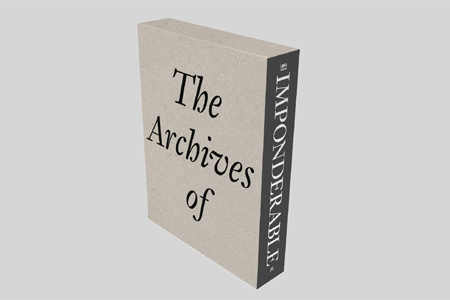
audience. That is a linear narrative for as close as I get to one a feature film with a true story but it’s also an art work.  Sometimes people just switch the language off entirely, which is a valid part of the experience — they might just want to look at the image, or catch one fragment and drift off into it, forgetting the rest of what’s being said. The pieces can have an almost organic quality that way like walking through a crowd, or overhearing a conversation. I’m happy to let the language peel away at different points. in the case of imponderable, there are many layers of language outside of the 5D film itself. There is the archive of artifacts related to the characters and themes as well as a fully Japanese flow chart, outlining characters, concepts, and historic events. There are so many ways for the Japanese audience to interact. Including the full script printed in the back of the catalog. 

David Bowie

S: There’s one thing I want to rave about — the Bowie-Branca piece, Empty.

TO: It’s a quadraphonic piece that was shot in 1999 and 2000,  a collaboration between Glenn Branca music , DavidBowie performance and me text and installation. Glennrecordedthe music, David came and recorded the text and did his performances for the camera , and it was never finished — only a short excerpt was ever released, semi-unintentionally bootlegged, which I put into Electronic Arts Intermix’s collection for a while. It was meant to beprojected onto four monolithic egg-shaped heads, with viewers wandering the room and the music swirling around them, an endless kind of recombining poem.

I first met David in 1996; he wanted to use my work in his live show at Madison Square Garden for his fiftieth anniversary , which he did, and I traded him a performance for it — I didn’t want any money, just an afternoon to shoot something it was such a thrill as he was an idol for me. I knew every note and word of his songs. I always thought, well I’ll never see him again   but we became friends. Lucky for me we worked on a few things together and  he ended up performing in a few works over the years which was wonderful and generous — what a character, this kind of shapeshifter, multiple-personality figure, in the best sense. I always thought of him as a harbinger of the internet, in the way It facilitated multiple-personality disorder. if you look at the history of MPDgoing back to Pierre Janet in France, He isolated to coexisting minds in one patient and later the book and film The Three Faces of Eve, from 1957 — a woman with three or four personalities, an obvious tale of a woman emancipating herself from a frustrating life by becoming someone else — anticipates something the internet would later make literal. By the time I met David, it was right before the internet, a kind of utopian tech moment, and I really felt that media’s ability to fragment the self also let you recombine the self in new formations, with all the world’s information leveled onto a single plane for anyone to sample. He was a symbol of volition. It was fantastic to have the chance to work with him.

S: I saw the show twice, and both times I watched people genuinely moved by the Bowie piece, staying with it. Writing to you afterward, I described it as almost Beckett-like: the cuts into somethingwholly abstract, returning to the face, dissolving it, this very painterly abstraction, then returning to him again, his face exploding like a constellation, like a nova. All this heightening his extraordinary voice performance — it felt like fireworks.

TO: — thank you, that’s a beautiful way to describe it. There was a real evolution in how it came together. There were no good opportunities to show the work and i let it drift in time knowing that one would come along. Then David’s death came as a shock too, sudden, and stunned everyone. Sadly Glenn died recently — there’d been a miscommunication and I hadn’t known how sick he was; I’d actually turned down one earlier chance to show Empty it in New York while he was still alive. 

I don’t have many projects like this one, hanging unfinished for so long — some artists work on something for twenty yearsdeliberately, but this piece mattered so much to me that I think I procrastinated on it simply because I wasn’t sure how to approach it, how to find the right moment for it, and then to make that moment feelintuitive rather than forced. I had a sense that it was time to finally finish the work: the next venue gets it no matter where that is. japan seemed perfect. 

Bowie was perfect for the text i was writing then in 1999 as all sorts of things resonated between us —William Burroughs’s cut- up technique, which we talked about quite a bit, and multiple-personality disorder as a media meme ( In the philosophical sense ) a kind of faux mental illness, a state of flux, that media amplification provoked, something I was already tracing toward the internet, even though the internet barely existed yet when we met. 

I brought in Glenn Branca too, since I knew he and David admired each other’s work. I was already in touch with Glenn — he was enthusiastic right away. The idea was that he’d compose a quadraphonic soundtrack that could be remixed in different combinations; he handed me a piece of music and told me to go ahead and remix it however I wanted. David came in to record the video — four variations of face painting, and four separate performances of the text, which overlap somewhat, all done under the working title Empty, or Empty Blue. Since this was around thirty years ago, I had to go back and really reread the text to remember what I’d actually intended. Going back into the footage, I was a little nervous, because there were resolution problems —

 I’d shot it on the first digital cameras available,  I thought at the time was a very high- resolution digital camera, but it turned out to be quite low-res; The between analog and digitalrhe resolution standards hadn’t been defined yet. Thisissue was probably part of why I kept putting the project off. Now, I was able to solve that with software that simply didn’t exist even a few years ago — there’s a real serendipity to the project having waited this long, since I couldn’t have finished it properly any earlier. Even though i was haunted by the loss of my friends. I listened to David’s four performances over and over. 

I don’t actually remember directing him much at all, though there’s some behind-the-scenes audio and footage I’ll share with you sometime, where he riffs on my name at one point — I’d asked him whether it was hard to keep his face still, locked into the frame, and mentioned that a friend of mine had found the same setup really disturbing to perform in. David joked that I was apparently subliminally into torturing my performers, and went off riffing on “Tony hours” for a while. “tony Owww rsler.” The four performances had his face painted in opposing primary colors, red and green — a strange, almost hellishly Christmas-colored effect — plus a more gestural, almost Joker-like version, and a fourth using an in-camera negative effect he was quite taken with. 

The script speaks of colors — blue, for me, has always been tied to film, television, that mnemonic glow of the tube, or the projector. But the underlying text isreally about the transition that happens through any kind of mediation, through the lens itself. I’d been writing the thematic timeline around that same period — the one that starts with the camera obscura — and eye imagery and projection tied back to that, a theme that’s run through my whole life, thinking about the space of mimetic play against reality. The text I wrote for David i imagined as acharacter being pulled through the lens into a virtual space, an inversion happening within light cones — something like two pyramid shapes in space, a dark region and a light region, above and below, as above, so below. As we live more in immediate world, we all have a visceral sense of this transformation with surveillance and computers.There’s an implicit subtext equating David himself with the character, since he spentmore time in front of a lens than almost anyone, using it deliberately to manipulate audiences and, in a way, to transform his own persona. The characters in the text move from flesh into light, from physical space intovirtual space — a contemplation, as best I could manage at the time, that also draws on the cultural connection between the phantasmagoria, magic, and the apparatus of the camera obscura.

That’s essentially how the piece evolved. Unlocking the text again was the first job — like reconstructing what I’d meant thirty years earlier, hoping I wouldn’t botch the chance I’d had to work with David and Glenn. To honor their memory and commitment to experimentation. 

Working on it now carried real weight, because both of these titanic figures, Glenn and David, are gone, and they have nothing left to say about it — I really wanted this to be a tribute to their creativity. Once reconnected to the text , the next step was timing. Originally I imagined the four performances recombining somewhat randomly, but I quickly realized it would take production of a computer team that wouldn’t work here — without it would just become cacophony, impossible to follow.

 So instead I tracked it out manually with all four faces meticulously synchronizedand worked through the text almost like an elaborate card game — Premiere’s editing tools make that kind of work far easier than it would have been even five years ago. I found the pacing and rhythm — one character, the green one, is aggressive, fast, almost yelling; another, split top to bottom, is much more passive. It was wonderful discovering how distinctly David had delivered these four different takes on the same text. They end up talking to each other, sometimes saying the same thing at once, sometimes simply complementing one another, moving from one character to the next.

This could change if I show the work again some place else but for this situation I mapped out the timing until it felt right, while building in blank spaces to give it room to breathe — thinking about how that would work spatially, bringing David’s face back in different ways: sped up, slowed down, runthrough AI with different prompts, with varying success, and at times getting genuinely spooked about whether to use any of that AI material at all but in the end it’s very subliminal hallucinogenic which I loveOut of the text came the idea of going through the lens, which meant I had to find a way to depict light itself — since David keeps turning into light in the piece — so I worked with lens flares, abstraction, colorization, effects, eventually incorporating stock footage alongside animated footage, AI material, manipulated and colorized versions of David, and references to psychedelia, even a bit of 3D modeling — since there’s a running media reference throughout the piece, and you can only gesture at that verbally so far in a visual medium. 

I came close to putting fireworks in at one point, and didn’t, though there are a couple of explosions. One discovery I made near the end: at several points in the text, he says, “May I have complete silence?” I realized that was a natural place for the piece itself to go silent and reset. Then the cacophony starts againThere’s also a moment where one character takes over all four faces before positioning the four egg-shaped sculptures/projection screens — and I thought, what if that had its own sound effect? I offset the faces six or eight frames apart and gave them a live delay effect, so you’re hearing an actual audio delay happening quadraphonically It’s a very simple trick, but I hadn’t quite seen it done that way before, and it felt fitting given David’s history as a musician — it has this rock- anthem quality to it, but it’s also literally concrete, a real delay you experience across four channels. A little audio magic.  

That’s also a tribute to editing in Premiere, honestly — being able to nudge a clip three, five, six, eight frames and get that effect.That’s how the piece finally came together.

S: It’s wonderful to hear all of that especially for the Japan show, because David is genuinely revered here — his relationship with Japan runs deep. People of a certain generation here adore him.

TO: Bowie fans will find a special dimension of his work here, and his commitment to art. They can become immersed. Play with shadows and selfies.one thing I hadn’t fully accounted for was how physical the piece is to move through; you really have to walk around it, more than I’d expected. Did you notice people moving through it thatway?

S:I had fun with it — I was moving around constantly myself, but I noticed Japanese audiences being almost too respectful, staying near the entrance, watching from a distance rather than stepping right in front ofit. I appreciated that, actually, it was very moving. And Glenn Branca’s music, the way it resonates with the visuals, is just epic — that particular wall of sound is so intense,and it really works. It’s remarkable how it all resonates together.

In a similar vein, I hadn’t seen Imponderablesince the LUMA show in 2015, and watching it again was both moving and genuinely stimulating. And of course, JG Thirlwell’s music throughout points to another great collaboration. The Frankenstein song is magical.

TO: Yeah, Jim did a great job on that. The Frankenstein song is a strange story — I wrote that melody myself, sang it into a cassette recorder half-asleep one morning, after essentially dreaming the song and waking up with the text already written. I sang it, in my own spastic way, for JimFletcher, the performer, not really knowing what he was capable of. I knew he was a great performer, but he just said, give me ten minutes, let me play it back a couple of times. He memorized the whole thing and sang it, and then Jim Thirlwell built the backing track around it.

I’m glad you loved that — honestly, I cried when Jim sang it, because it was one of the last things we shot for the film, and it was incredible that he was able to make it that moving. Thirlwell is a master of so many genres — he’s had a substantial career in television too, cartoons, soundtracksgenerally — so he knew exactly what to do, and he raised the level of the whole filmbecause of it.

I’m really glad to hear those reactions, from you, from the Tokyo visitors to the show. It’s great that this could finally happen!


Exhibition Review

Tony Oursler: Tech/Gnosis-Magic, Media, Art

photo: Keizo Kioku

The day after the opening of this Tony Oursler exhibition in Tokyo — his largest in Japan — Tokyo Node hosted a conversation with the artist, the two curators, and two guests, Minoru Hatanaka, who built his career at the ICC Center, and architect Shohei Shigematsu from OMA. The full room drew an audience that included members of Oursler’s generation, and many young women students who came with sharp questions and a wish to pose with the artist for the sake of Instagram selfies and TikTok moments. The flyer, for that matter, leaned into this same spirit, its graphic design promising a fun experience, even though this was contemporary art.

Tokyo Node is a new space run by the Mori Group, which also includes the Mori Art Museum, and the Tony Oursler exhibition marks their first collaboration with an international artist. Conceived by independent curator Alice Nienpu Ko and Reiko Tsubaki of the Mori Art Museum, Tony Oursler: Tech/Gnosis-Magic, Media, Art benefits from a keen  selection of works chosen for each room, all of which reveal the sheer proliferation of forms and narrative fields at play: single-channel tapes, sculptures, installations, drawings, archives. Specular (2021), an installation of spheres of varying sizes onto which projected eyes turn in every direction, opens the show. The spectator then enters a psychotropic, surveillance-laden universe, crossing paths with more than one character addressing itself, often played by Oursler himself. Among them hangs the flagship piece F/X Plotter, one of his earliest projections onto a dummy, first shown at Documenta IX in 1992. It announces a climate of intrigue and conspiracy. For Oursler never stops thinking through, conceptualizing the consequences of being elsewhere and otherwise.

Although he emerged shortly after Bill Viola, Gary Hill, or John Sanborn, he belongs just as much to another group of artists who came out of CalArts, among them Mike Kelley and Jim Shaw — accomplices who haunt the unsettling apparatus of the exhibition’s early rooms, underscoring the role collaboration plays throughout his work. Constance DeJong, Kim Gordon, JG Thirlwell, Glenn Branca — icons of New York subcultures — accompany him from one decade to the next. 

Nonetheless, he shares with his peers in video this drive to free the image, to pull it out of the monitor and give it other roles, placing him alongside artists ranging from Gary Hill to Philippe Parreno. Alice Nienpo Ko explained how much this remark by the artist’s — “I’m interested in the space where light goes once it leaves the monitor; where life begins and the machine ends” — had guided her choices back in 2021, when she organized Black Box, an Oursler retrospective at the Kaohsiung Museum of Fine Arts in Taiwan (1). That exhibition foregrounded the archive he began building in the 2000s on the history of the camera obscura, tracing the paths of the image toward other territories, from science to spiritualism. 

A history of images ready to move before the arrival of the moving image itself — including images manifesting themselves somewhere other than on a screen — crystallizes in his film Imponderable (2015) (2).

But this exhibition at Tokyo Node is turned toward the present and the future. It marks a new encounter between Tokyo audiences and Oursler’s work. It allows the curator to put forward another reading of his work, one grounded in the idea of magic and a wish to move past the fascination with the supernatural so often attached to it. Oursler lends himself to this idea; the path of Tech/Gnosis-Magic, Media, Art unfolds in a demonstration of how belief systems continue to exist within technologically advanced societies. A further curatorial stake proposes to see modernity as a “process of disenchantment” (3), in which the rational dimension of science replaces myth, ritual, and magical knowledge — and that, on the contrary, Oursler’s work rises up against this account with the arrival of each new technology, from the Porta-Pak to AI, in order to reach another model of enchantment (4).

Let us finally turn to Empty (2000–2026), his collaboration with David Bowie and Glenn Branca. Oursler explains, in the interview that follows this text, how Bowie encountered his work in 1996. In 1999–2000, he agreed to perform texts Oursler had written for him. Branca composed a score that accompanies, responds to, provokes. It took the artist years to arrive at a version he still hesitated to show them; Bowie and Branca both died before seeing it completed. Footage from that shoot did appear before, notably in Face to Face, in Aarhus, Denmark, in 2012 (5).

photo: Yuya Furukawa

The Tokyo Node project prompted a return to the piece, and the installation is among the strongest moments for Japanese audiences. Bowie wore Yamamoto Kansai’s costumes in the 1970s, spent time in Kyoto, became passionate about Kabuki, appeared in sake commercials, and formed a friendship with Ryuichi Sakamoto — the list goes on. The apparatus recalls Anthony Minghella’s filmed version of Samuel Beckett’s Play, in which Alan Rickman recites his lines while trapped inside an enormous urn. Empty projects Bowie’s face onto four egg-shaped objects; they converse, ignore one another, say nothing, then suddenly raise their voices. Bowie once again delivers an unforgettable performance, shot in a New York artist’s studio, allowing us to grasp the distance traveled since that filmed portrait of Bowie by Andy Warhol at the Factory in the early 1970s.

The audience held an almost reverent bearing in this room, and the title Empty underscores this place now left vacant. Let us dare say that magic passed through that space.

1 — Conversation with Alice Nienpu Ko

2 — https://tonyoursler.com/imponderable-moma

3 — idem 1

4 — These readings are developed in the book accompanying the exhibition, with texts by both curators and by Minoru Hatanaka.

5 — https://tonyoursler.com/face-to-face