Lost in Translation: Nolan’s The Odyssey
Odysseus took long enough to reach Japan, making it to Tokyo in September, after the film had already grossed over a billion dollars. Never had a classic text enjoyed such promotion, with the filmmaker in tow and in town around the globe, as well as a clan incarnating new power and actual bonds, made up of Tom Holland, Zendaya, Jon Bernthal, and Robert Pattinson.
Christopher Nolan inevitably brought up Jason and the Argonauts during interviews, with its celebrated stop-motion effects by Ray Harryhausen. However, he did not go out of his way to mention, in the spirit of the myth, the character of Medea.
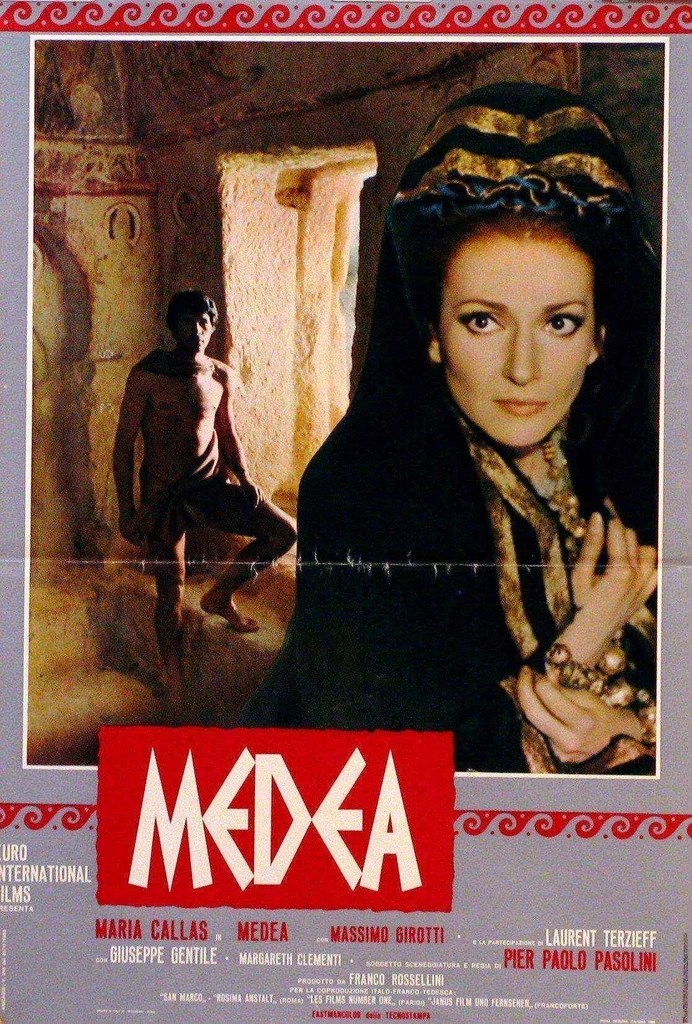
Not unlike Helen tusked away by Paris, Jason makes off with Medea, chased by the king’s soldiers. We may recall Medea had killed Jason’s intended new bride, or that she butchered her brother Apsyrtus, leaving pieces of him on the road when they originally fled after taking the Fleece. It might have proven ‘generous and scholarly’, an image Nolan likes to display, to point to Pier Paolo Pasolini’s Medea and Maria Callas’ otherworldly performance. But these are two filmmakers who aren’t speaking the same language.
Medea also makes a troubling appearance in Madeline Miller’s remarkable book Circe. The character’s depiction in The Odyssey -by Samantha Morton- has been widely praised. She is not Miller’s Circe, but is she closer to Emily Wilson’s version, the translation selected by the director ? Who would claim ownership? Morton’s performance carries a rough britishness as opposed to Holland, who effortlessly drops americanisms. Telemachus’ parents do speak after all with a clear American accent. Yet both British actors project indignity as a credibly hungry thing. But Ithaca is where all manners of English are spoken and perhaps this is true of other Greek islands, as does Troy. Priam spoke one and Achilles another in the Wolfgang Petersen film, to which, Nolan recalled, he was briefly attached.
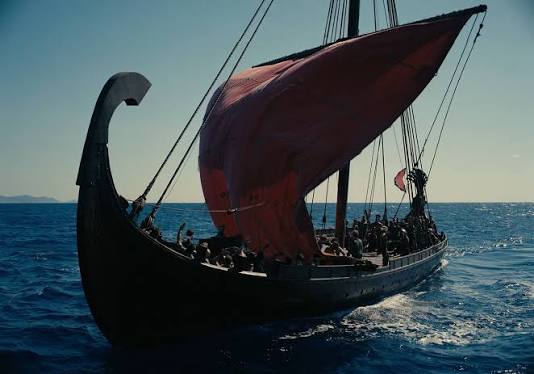
Nobody endures the wrath of Poseidon, he loses men to Scylla, survives the sirens, is shipwrecked in the arms of Calypso and her tricks with memory, possibly having forgotten Nausicaa in the process; several major scenes take place at sea. As with his most accomplished and satisfying film, Dunkirk, Nolan demonstrates again how he excels at being on water and staging drama on a ship. Perhaps a film solely about reaching one island at a time, without Odysseus ever setting foot on a beach, might have provided an opportunity for another boat yarn in his filmography. Much was lost at sea.
Agaguk, The Residents in Tokyo
The Residents, Eskimo, Tokyo Blue Note, Sept. 8, 2026
A revered ensemble of the alternative scene, the collective The Residents, formed in San Francisco in the early ’70s, incorporated various visual media into every album release from the outset. Homer Flynn, founding member of the group and spokesperson for their company Cryptic Corporation, pointed to how each decade resonated through conceptually distinct means. The Residents never performed live during the ’70s; each album was only ever played by them once, in the studio (1). Beyond the extraordinary graphic design for each cover and poster, videos made with the tools of the era accompanied releases such as Third Reich n’ Roll. Their theory of obscurity underscored this project of anonymity; the group’s members always appeared in masks and costumes, refusing to reveal their identities, urging the audience to focus on the performance. Flynn, responsible for the group’s graphic design across five decades, remains to this day the official face of the group.
The first samplers of the ’80s, the Emulators, allowed them to reproduce their sound textures and undertake a series of international tours, and whose use of theatricality made them a foundational influence that continues to this day, as seen in the Québécois duo Angine de Poitrine. They stopped performing live during the ’90s to focus on computer graphics and CD-ROMs — they released three, well received by critics — before resuming performances in the 2000s.

Eskimo, released in 1979, gathered genuine elements of Inuit folklore and approximate anthropological research, in the manner of ethnographic forgers (2). It already announced a postmodern dimension, a self-referentiality expanding the parameters of a strategy since refuted — cultural appropriation, parodied by the group. In 2025, the group, lucid and aware of possible misunderstandings, performed the album in its entirety onstage, adding two new pieces and a staging featuring the group’s frontman and three musicians in yeti-like costumes, this time favoring the narrative dimension and letting AI reveal the excesses of the ethnographic decoy.
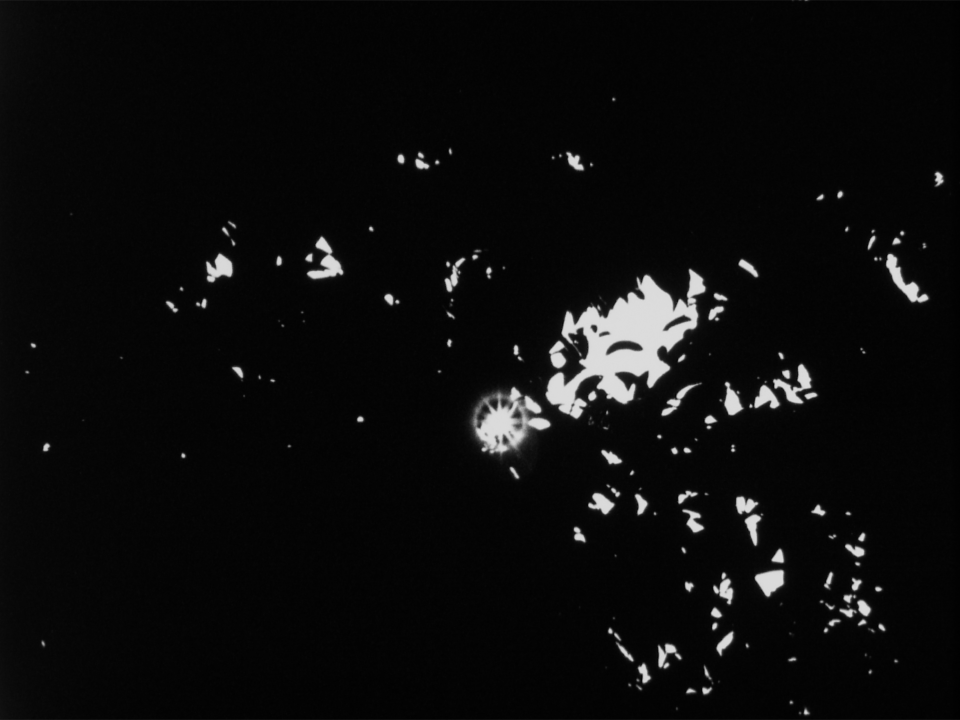
In 2003, a DVD had already been released in which the chapters of the story were illustrated using images and archetypes — the igloo and the kayak, the walrus and the hunter. These had a bluish black-and-white texture. For this tour, nine clips were created by AI from the DVD’s images. One of them was made by John Sanborn, who went on to become an important collaborator of Homer Flynn’s, releasing a portrait of The Residents, The Eyes Scream, as early as 1991.
The animation also indulges in this homogeneity of an image owing something to both morphing and the slickness of 3D, producing immediately identifiable images that don’t hesitate to draw an almost perverse pleasure from this process.
The Residents demonstrate, right at the end, how this culture does not escape this tool — and how the polar bear, that other hunter once prowling the ice floes, feared by those in kayaks, became an emblem of Coca-Cola. A performance barely an hour long, without a single false note.
1 — An interview with Homer Flynn on the history of the relationship between The Residents and image technologies will appear later this fall.
2- And not unlike the compression of hurried inaccuracies in this short text.
Eskimo live setlist:
The Walrus Hunt (Abridged) —
Birth (Abridged) —
Arctic Hysteria (Abridged) —
The Tale of Two Tupilaqs (New song) —
The Angry Angakok (Abridged) —
A Spirit Steals a Child (Abridged) —
The Skeleton at the Bottom of the Sea (New song) —
The Festival of Death (Abridged) —
Diskomo (Abridged) —
And what a woman broke in the process
Idemitsu Mako, What a Woman Made
Curated by Tasaka Hiroko and Endo Miyuki
Tokyo Photographic Art Museum, 18-6 to 21-9 2026
Slowly but surely, the work of Idemitsu Mako found allies in Japan who would engage in having it rediscovered and, more importantly, locate it in a number of ways contemporary art history was being narrated. From being there at the emergence of an international feminist art practice to finding its place in Japan’s own art history.
Which is not to say that this is the locus of this exhibition. The sensitive and sophisticated arrangement of Idemitsu’s work – from her films of the seventies, her seminal videos of the eighties, the broader projects of the nineties, to the overtly autobiographical installations of the early 2000s – does not stray too far from the story the artist has told. It consists of radical decisions and epic encounters, most ‘tellingly’ going to America as a young woman, marrying the painter Sam Francis, being thrown out of the family by her father, becoming a mother and living between the US and Japan, picking up a 16mm camera, then a video camera, to look at what was around her. Which meant what was nearby.
The exhibition has the particular merit of introducing many of her early films to a young audience, even though they are digitized and are cheated out of their medium’s process. But by contrast to what would later follow, they go outside. We see clouds, sunsets, trees, the use of slow motion, and an organic use of the black and white image in 1974’s At Yukigaya 2 (where she lived in Tokyo) and 1975’s at Santa Monica 3. The California environment, the support of artists like Bruce Connor, took her out of the house. However, What a Woman Made (1973) came during a visit to Japan. Rather than continue to seek escape and solace, her work began to point at the problem and fight back, though it still enjoyed going out and adding clouds and gardens to her encounters with feminism .
Not too long after this, she became an artist of interiors, telling us about the trappings of women caught in marriage, in a home, under constant peer pressure. She also became a writer, a director who worked with performers, an archivist of unfulfilled torments and longings, of projected desires.
Critics in Japan made much of what they termed the Mako style, as exemplified in 1977’s Another Day of a Housewife, in which a small monitor -they would get bigger- appears in the frame, a trope that took on different character roles throughout her work of the 80s. Dialogue with the medium defined much of video art history in its first decades, from Paik to Campus to Graham.
But Idemitsu Mako anticipated the omniscient social role it would play, how screens spoke back to us.
These works also function as a scathing critique of the bubble years, of the assignation of roles to women as housewives and men as providers and keepers of power. In this respect, it is odd that essays in the truly wonderful catalogue for the show rely so intently on interviews with the artist through the years. Carl Jung, a seventies California reference, is repeatedly quoted, from the Animus to the Great Mother. A case could be made here for readings using Freud or Lacan, but that just adds to the problem. Not invoking Judith Butler, Monique Wittig, Luce Irigary, Vinciane Despret, or Ueno Chizuko, in this project, offers new opportunities to another generation of writer-curators to engage with her work.
Nonetheless, the experience of going through the exhibition, from the opening declaration made by What a Woman Made to the closing reassessment of family history in 2004’s The Past Ahead, is moving, poetic, and powerful. It also tells the tale of where she ultimately decided to stay and make work.
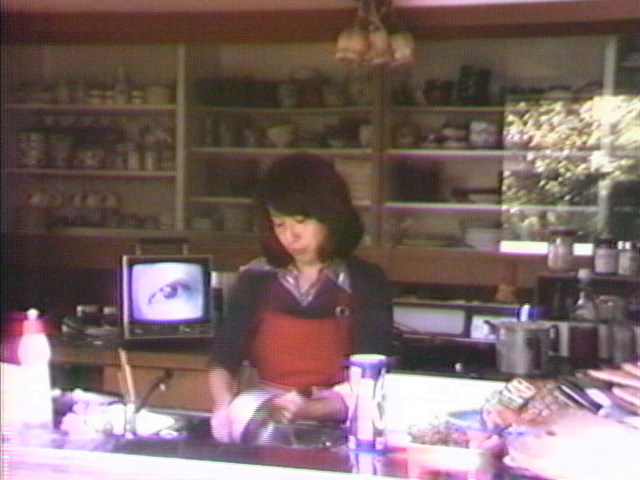
Idemitsu Mako, Another Day of a Housewife , 1977, Collection of Tokyo Photographic Art Museum ©Mako Idemitsu
Idemitsu Mako, At Yukigaya 2 , 1974, Collection of Tokyo Photographic Art Museum ©Mako Idemitsu
Candy that makes the hurt come faster
Reiko Hiroshima, Curry Barker, the first a Japanese writer whose Fushigi Dagishaya Zenitendo is a book series published since 2013, adapted to manga and anime, and the second, an American YouTube content creator whose first feature film Obsession is one of two American films (1) rewriting Summer movie rules at this particular moment in film history. Tellingly, this is happening when the power of studios, having undergone a 21st century existential trauma with the emergence of streaming, is now experiencing the full assault of acquisition and merger politics. By comparison, Amazon’s purchase of MGM appears almost civil. Obsession might almost feel like an act of resistance, were it for the fact that it blossomed in the fields of Google.
I spend time there as well, I subscribe to various YouTube channels. I used to watch the Criterion Closet when filmmakers and actors with a connection to cinema came in to select titles. Some entered with expected choices, others more surprising, and there were those who spoke knowingly, movingly about specific films. I remember the modesty of Cilian Murphy asking if he could take the Wes Anderson box set. But more recently, I am either clueless as to who the guest is, or unable to watch through because how many times can the same Albert Brooks (whom I often confuse with Charles Grodin) title be their go-to movie. Possibly more the point, a new cinephilea is being recorded here by 21st century media figures who pick a Coen Brothers film and one of the few contemporary comedies released on Criterion, usually Amy Heckerling’s (1982…) Fast Times at Ridgemont High with 22-year old Sean Penn. This when Obsession is up against a Jon Favreau film and the attempt, as pleasant as he might be, to make him an auteur because like Lucas he knows Kurosawa films. I bring this up as a possible archival strategy, the one built in small spaces as opposed to warehouses, the closet at Criterion, the bedrooms with background neons and Shure microphones of YouTube movie reviewers. Nothing similar ever took place in Japan for cinema, where Tokyo, once one of the truly great cities showing international films all year round, glided easily at the turn of the century towards film amnesia rather than immemory, starting with its own breathtaking film history.
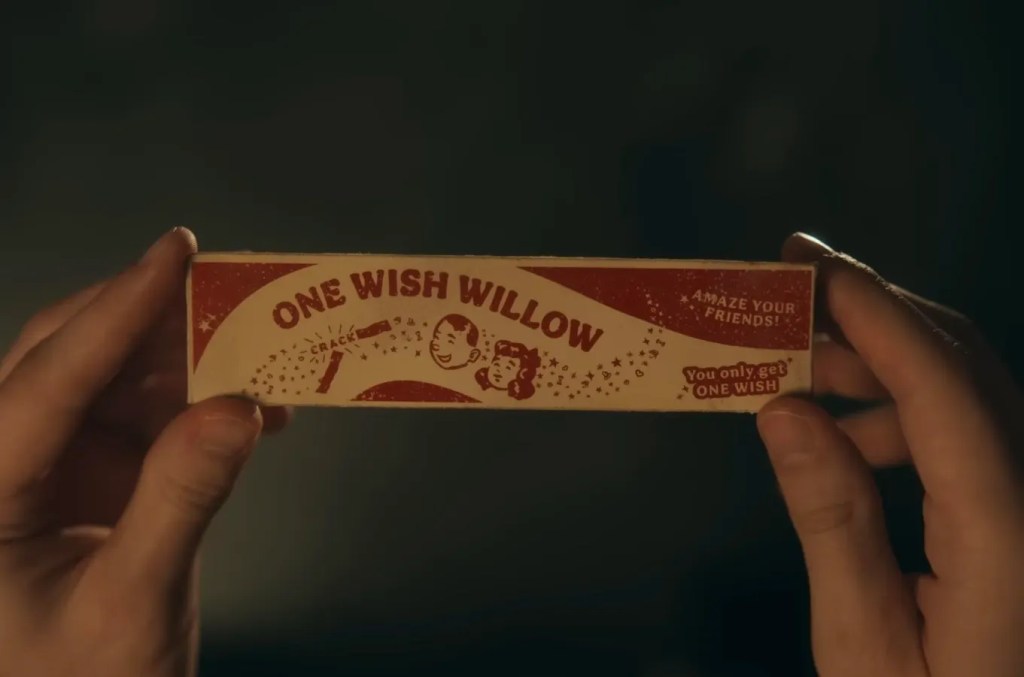
Which brings me back to Barker’s Obsession. A clever, well acted, well framed film. It is neither Magnificent nor even Odd, nor does it have Geneviève Bujold. For those overwhelmingly familiar with modern American horror cinema, or even US tv dramas/sitcoms/romcoms, Nikki Freeman (Inde Navarrette) appears intensely collegiate and a being of social media. Michael Douglas did not need to wish for that version of Glenn Close in Fatal Attraction; she was fully formed, as was Jessica Walter in Play Misty for Me. The becoming of Nikki Freeman can be a signpost for the YouTube changing Hollywood narrative. I mentioned the Obsession plot to my wife who observed that this was close to what happens in Zenitendō, in which a shopkeeper offers candy suited to help those who come to her with problems; the candy, depending if it’s used correctly, will either bring joy or trouble. How difficult the story would have been for the Bear character if the wish came as a vaccine.
1- Backrooms, by Kane Parsons.
Reiko Hiroshima, Curry Barker, la première, autrice japonaise dont la série Fushigi Dagashiya Zenitendō est publiée depuis 2013, adaptée depuis en manga et en anime, et le second, un Américain, content creator sur YouTube dont le premier long métrage, Obsession, est l’un des deux films (1) en train de réécrire les règles du blockbuster à ce moment précis de l’histoire du cinéma. De manière révélatrice, cela se produit alors que le pouvoir des studios, ayant traversé un traumatisme existentiel au cours du XXIe siècle avec l’émergence du streaming, subit désormais l’assaut complet des politiques de rachat et de fusion. On se laisserait aller à croire que l’acquisition de MGM par Amazon fut presque courtoise. Obsession pourrait s’afficher comme simulacre d’un acte de résistance, si ce n’était qu’il a vu le jour dans les moissons de Google.
J’y passe du temps parfois, je suis abonné à diverses chaînes YouTube. Je regardais autrefois le Criterion Closet, lorsque des réalisateurs et acteurs ayant un lien avec le cinéma venaient y choisir des titres. Certains arrivaient avec des choix attendus, d’autres plus surprenants; on y croisait ceux qui savaient s’exprimer avec intelligence et émotion à propos de films précis. Je me souviens de la modestie de Cillian Murphy demandant s’il pouvait prendre avec lui le coffret Wes Anderson. Mais plus récemment, je n’ai aucune idée de qui est l’invité, ou je n’arrive pas à regarder jusqu’au bout, tant on se demande combien de fois le même titre d’Albert Brooks (que je confonds souvent avec Charles Grodin) peut être leur film de référence. Plus encore porteur, peut-être, une nouvelle cinéphilie est en train de naître ici, celle de figures médiatiques du XXIe siècle qui choisissent un film des frères Coen et l’une des rares comédies contemporaines chez Criterion, le choix consensuel étant Fast Times at Ridgemont High (1982…) d’Amy Heckerling, avec un Sean Penn de 22 ans. Ceci alors qu’Obsession sort en même temps qu’un film de Jon Favreau; la tentative devient admise de faire de lui un auteur parce que, comme Lucas, il connaît les films de Kurosawa. J’évoque cela comme une possible stratégie d’archive, celle qui se construit dans de petits espaces plutôt que dans des entrepôts : le placard du Criterion, les chambres aux néons d’ambiance et micros Shure des critiques de cinéma sur YouTube. Rien de semblable n’a jamais eu lieu au Japon pour le cinéma, où Tokyo, autrefois l’une des grandes villes projetant des films internationaux toute l’année, a glissé sans effort, au tournant du siècle, vers une amnésie cinématographique plutôt qu’une immemory — à commencer par sa propre histoire du cinéma, pourtant fabuleuse .
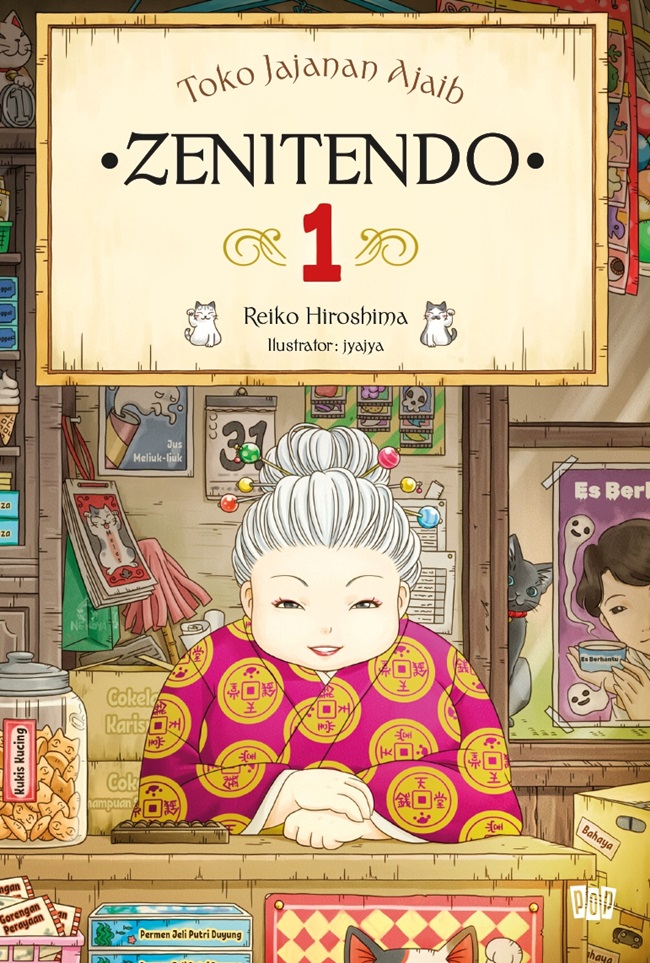
Ce qui me ramène à Obsession de Barker. Un film habile, bien interprété, bien cadré. Il n’est ni Magnificent façon Sirk, ni même Odd comme chez Roeg, et on n’y retrouve pas Geneviève Bujold. Pour ceux qui connaissent de près le cinéma d’horreur américain, ou même les séries/sitcoms/comédies romantiques télévisées, les emportements, les cris, de Nikki Freeman (Inde Navarrette) la rendent intensément reconnaissable, comme une figure sortie des réseaux sociaux. Michael Douglas n’avait pas besoin de souhaiter cette version de Glenn Close dans Liaison fatale ; elle était déjà entière et présente, tout comme Jessica Walter dans Play Misty for Me. Le devenir de Nikki Freeman peut être vu comme un indicateur du récit hollywoodien transformé par YouTube. J’ai raconté l’intrigue d’Obsession à ma compagne, qui a remarqué que cela se rapprochait de ce qui se déroule dans Zenitendō, où une commerçante propose des bonbons adaptés aux problèmes de ceux qui s’y rendent ; le bonbon, selon qu’il est utilisé correctement ou non, apportera ou la joie, ou des ennuis. Combien l’histoire aurait été difficile pour le personnage de Bear si le souhait s’était présenté sous forme de vaccin.
1- Backrooms, de Kane Parsons
La Barrière de la Chair
La Cinémathèque Française programme du 10 au 24 juin 2026 une sélection Roman Porno du studio Nikkatsu, le plus vieux studio de cinéma au Japon. La production de ces films permit d’observer (ce que l’on croit encore devoir nommer) la marge empêchant la fermeture du studio et de sauver les équipes et les emplois. Je m’étais entretenu avec deux maîtres du genre, tout d’abord avec Tanaka Noboru lors d’une rétrospective de ses films dans la salle d’art et d’essai La Puta, à Tokyo, et plus longuement avec Konuma Masaru.
Tout cela était paru dans la chronique SoOtaku sur une version antérieure du site des Cahiers du Cinéma, puis en 2015 dans mon livre Réponses du Cinéma Japonais Contemporain, et enfin dans le coffret Roman Porno que j’ai co-dirigé pour l’éditeur dvd Éléphant paru en 2019, pour lequel j’ai également rédigé l’ouvrage L’Aventure du Corps dans le Cinéma Japonais.
Deux séances seront présentées par Clara Sebastio, que je découvre (1).
A Tokyo, Hasebe Yasuharu (2), l’un des réalisateurs les plus extrêmes du genre voyait son oeuvre faire l’objet d’une étude remarquable par une chercheuse Japonaise, Mio Hatokai. Son film Les Femmes de la bourrasque, plus retenu, est au programme, qui compte huit titres qui ont écrit l’histoire du Roman Porno, des Amants Mouillés de Tatsumi Kumashiro (1971) à Love Hotel de Shinji Somai (1985).
J’ai beaucoup écrit sur, et parlé de, ces films en France. Le réalisateur Konuma Masaru, qui a signé quelques uns des films les plus incandescents de l’histoire du cinéma japonais, me raconta longuement les tournages de ses films et les ambitions de ses pairs chez Nikkatsu, tous issus de milieux sociaux plus modestes, conscients de ne pas appartenir aux univers des studios Shochiku et Toho.
Je pense moins en ce moment à ce que j’ajouterais de plus à mes textes parus il y a près de dix ans, et davantage à ce qu’on ne peut plus dire de ces films. Ce qui doit sauter.
1- Avec l’espoir qu’une trace d’une de ses interventions sera disponible sur le site de la Cinémathèque.
2- On lui doit l’important Black Tight Killers, de 1966, qui aura une véritable sur le cinéma d’action de Hong Kong. Le site Midnight Eye compte quelques textes sur les films de Hasebe.
The Gate of Flesh
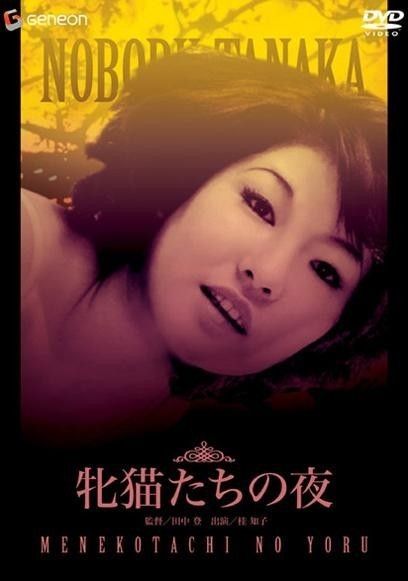
The Cinémathèque Française is programming a Roman Porno selection from the Nikkatsu studio — Japan’s oldest film studio — from June 10 to 24, 2026. The making of these films made it possible to observe what one still feels compelled to call the margin and how it prevented the studio from closing and saved jobs and crews. I had spoken with two masters of the genre: first with Tanaka Noboru at a retrospective of his films at the art-house cinema La Puta in Tokyo, and at greater length with Konuma Masaru. Versions of this had appeared in the SoOtaku column on an earlier iteration of the Cahiers du Cinéma website, then in 2015 in my book Réponses du Cinéma Japonais Contemporain, and finally in the Roman Porno box set I co-edited for the DVD publisher Éléphant, released in 2019, for which I also wrote the volume L’Aventure du Corps dans le Cinéma Japonais.
Two screenings will be presented by Clara Sebastio, whose work I’m discovering (1).
In Tokyo, Hasebe Yasuharu (2) — one of the most extreme directors of the genre — saw his work be the subject of a remarkable study by a Japanese researcher, Mio Hatokai. His film Women in a Windstorm, a more restrained selection, is on the programme, which includes eight titles that wrote the history of Roman Porno, from Tatsumi Kumashiro’s Wet Lovers(1971) to Shinji Somai’s Love Hotel (1985).
I have written a great deal about these films in France, and spoken about them at length. The director Konuma Masaru, who made some of the most incandescent films in the history of Japanese cinema, told me at length about the shoots and the ambitions of his peers at Nikkatsu — all from more modest social backgrounds, all aware that they did not belong to the world of the Shochiku and Toho studios.
I am thinking less at this moment about what I would add to texts published nearly ten years ago, and more about what can no longer be said about these films. What must be cut.
1 — With the hope that a record of one of her talks will be available on the Cinémathèque’s website.
2 — We owe him the important Black Tight Killers (1966), which would have a genuine influence on Hong Kong action cinema. The Midnight Eye website carries several texts on Hasebe’s films.

