Idemitsu Mako, What a Woman Made
Curated by Tasaka Hiroko and Endo Miyuki
Tokyo Photographic Art Museum, 18-6 to 21-9 2026
Slowly but surely, the work of Idemitsu Mako found allies in Japan who would engage in having it rediscovered and, more importantly, locate it in a number of ways contemporary art history was being narrated. From being there at the emergence of an international feminist art practice to finding its place in Japan’s own art history.
Which is not to say that this is the locus of this exhibition. The sensitive and sophisticated arrangement of Idemitsu’s work – from her films of the seventies, her seminal videos of the eighties, the broader projects of the nineties, to the overtly autobiographical installations of the early 2000s – does not stray too far from the story the artist has told. It consists of radical decisions and epic encounters, most ‘tellingly’ going to America as a young woman, marrying the painter Sam Francis, being thrown out of the family by her father, becoming a mother and living between the US and Japan, picking up a 16mm camera, then a video camera, to look at what was around her. Which meant what was nearby.
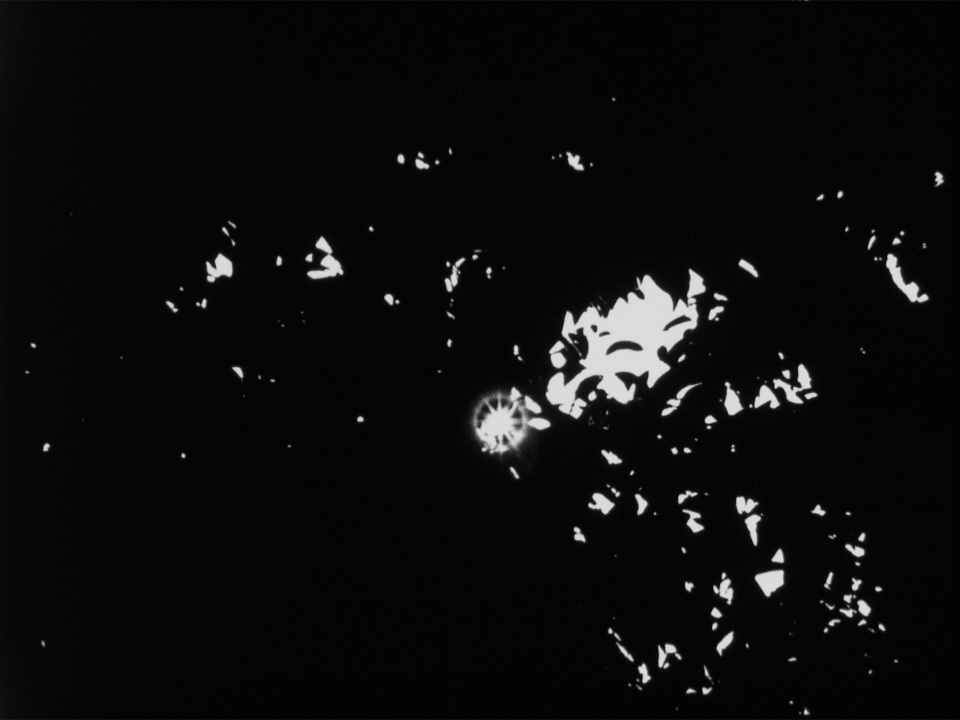
The exhibition has the particular merit of introducing many of her early films to a young audience, even though they are digitized and are cheated out of their medium’s process. But by contrast to what would later follow, they go outside. We see clouds, sunsets, trees, the use of slow motion, and an organic use of the black and white image in 1974’s At Yukigaya 2 (where she lived in Tokyo) and 1975’s at Santa Monica 3. The California environment, the support of artists like Bruce Connor, took her out of the house. However, What a Woman Made (1973) came during a visit to Japan. Rather than continue to seek escape and solace, her work began to point at the problem and fight back, though it still enjoyed going out and adding clouds and gardens to her encounters with feminism .
Not too long after this, she became an artist of interiors, telling us about the trappings of women caught in marriage, in a home, under constant peer pressure. She also became a writer, a director who worked with performers, an archivist of unfulfilled torments and longings, of projected desires.
Critics in Japan made much of what they termed the Mako style, as exemplified in 1977’s Another Day of a Housewife, in which a small monitor -they would get bigger- appears in the frame, a trope that took on different character roles throughout her work of the 80s. Dialogue with the medium defined much of video art history in its first decades, from Paik to Campus to Graham.
But Idemitsu Mako anticipated the omniscient social role it would play, how screens spoke back to us.
These works also function as a scathing critique of the bubble years, of the assignation of roles to women as housewives and men as providers and keepers of power. In this respect, it is odd that essays in the truly wonderful catalogue for the show rely so intently on interviews with the artist through the years. Carl Jung, a seventies California reference, is repeatedly quoted, from the Animus to the Great Mother. A case could be made here for readings using Freud or Lacan, but that just adds to the problem. Not invoking Judith Butler, Monique Wittig, Luce Irigary, Vinciane Despret, or Ueno Chizuko, in this project, offers new opportunities to another generation of writer-curators to engage with her work.
Nonetheless, the experience of going through the exhibition, from the opening declaration made by What a Woman Made to the closing reassessment of family history in 2004’s The Past Ahead, is moving, poetic, and powerful. It also tells the tale of where she ultimately decided to stay and make work.
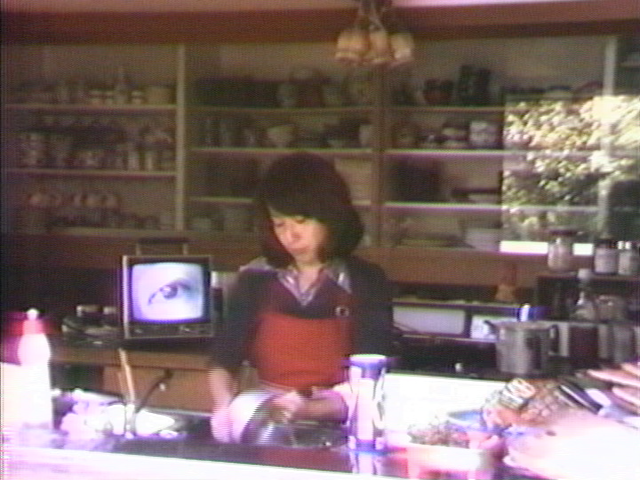
Idemitsu Mako, Another Day of a Housewife , 1977, Collection of Tokyo Photographic Art Museum ©Mako Idemitsu
Idemitsu Mako, At Yukigaya 2 , 1974, Collection of Tokyo Photographic Art Museum ©Mako Idemitsu
 constance-mdc