2026.7.3 (Fri) – 2026.9.27 (sun), Tokyo node
The day after the opening of this Tony Oursler exhibition in Tokyo – his largest in Japan – Tokyo Node hosted a conversation with the artist, the two curators, and two guests, Minoru Hatanaka, former ICC Center chief-curator, and architect Shohei Shigematsu from OMA. The full room drew an audience that included members of Oursler’s generation, and many students who came with keen questions and requests to pose with the artist for the sake of Instagram selfies and TikTok moments. The flyer, for that matter, leaned into this same spirit, its graphic design promising a fun experience, even though this was contemporary art.
Tokyo Node is a new space run by the Mori Group, which also includes the Mori Art Museum, and the Tony Oursler exhibition marks their first collaboration with an international artist. Conceived by independent curator Alice Nien-Pu Ko and Reiko Tsubaki of the Mori Art Museum, Tony Oursler: Tech/Gnosis-Magic, Media, Art benefits from an inspired selection of works chosen for each room, all of which reveal the sheer proliferation of forms and narrative fields at play: single-channel tapes,sculptures, installations, drawings, archives. Specular (2021), an installation consisting of spheres of varying sizes with projected eyes turned in every direction, opens the show. The spectator then enters a psychotropic, surveillance-laden universe, crossing paths with more than one character addressing itself, often played by Oursler himself. Among them hangs the flagship piece F/X Plotter, one of his earliest projections on a dummy, first shown at Documenta IX in 1992. It announces a climate of intrigue and conspiracy. For Oursler never stops thinking through, conceptualizing, the consequences of being elsewhere and otherwise.

Although he emerged shortly after Bill Viola, Gary Hill, John Sanborn, he belongs just as much to another group of artists who came out of CalArts, among them Mike Kelley and Jim Shaw — accomplices who haunt the unsettling apparatus of the exhibition’s early rooms, underscoring the role collaboration plays throughout his work. Constance DeJong, Kim Gordon, JG Thirlwell, Glenn Branca — icons of New York subcultures — accompany him from one decade to the next.
Nonetheless, he shares with his video peers this drive to free the image, to pull it out of the monitor and give it other roles, placing him alongside artists ranging from Gary Hill to Philippe Parreno. Alice Nien-Pu Ko explained how much this remark by the artist’s — « I’m interested in the space where light goes once it leaves the monitor; where life begins and the machine ends » — had guided her choices back in 2021, when she organized Black Box, an Oursler retrospective at the Kaohsiung Museum of Fine Arts in Taiwan (1). An exhibition that manifested the archive he began building in the 2000s on the history of the camera obscura, tracing the paths of the image toward other territories, from science to spiritualism. A history of images ready to move before the arrival of the moving image apparatus itself — including images materializing elsewhere than on a screen — crystallizes in his film Imponderable (2015) (2).
But this exhibition at Tokyo Node is turned toward the present and the future. It marks a new encounter between Tokyo audiences and Oursler’s work. It allows the curator to put forward another reading of his work, one grounded in the idea of magic and a wish to move past the fascination so often attached to the supernatural. Oursler lends himself to this idea; Tech/Gnosis-Magic, Media, Art unfolds in a demonstration of how belief systems continue to exist within technologically advanced societies. A further curatorial stake proposes to see modernity as a « process of disenchantment » (3), in which the rational dimension of science replaces myth, ritual, and magical knowledge — and that, on the contrary, Oursler’s work rises up against this account with the arrival of each new technology, from the Porta-Pak to AI, in order to reach another model of enchantment (4).
Let us finally turn to Empty (2000–2026), his collaboration with David Bowie and Glenn Branca. Oursler explains, in the interview that follows, how Bowie encountered his work in 1996. In 1999–2000, he agreed to perform texts Oursler had written for him. Branca composed a score that accompanies, responds to, provokes. It took the artist years to arrive at a version he still hesitated to show them; Bowie and Branca both died before seeing it completed. Footage from that shoot did appear before, notably in Face to Face, in Aarhus, Denmark, in 2012 (5).
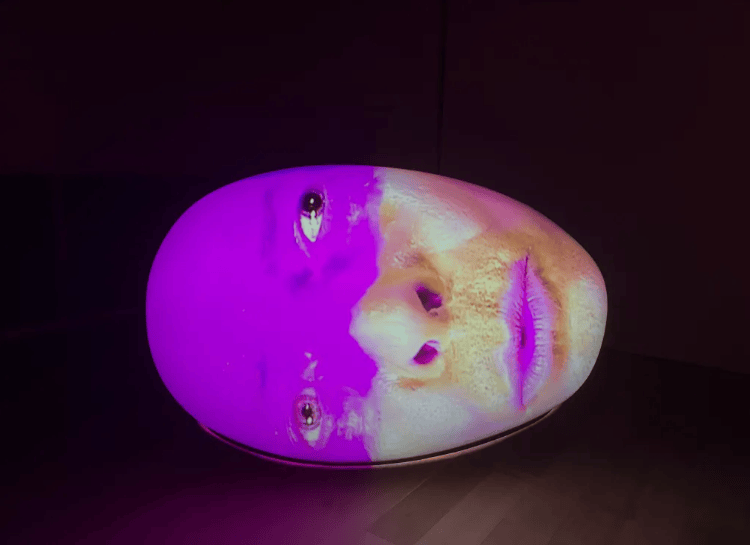
The Tokyo Node project prompted a return to the piece, and the installation is among the strongest moments for Japanese audiences. Bowie wore Yamamoto Kansai’s costumes in the 1970s, spent time in Kyoto, became passionate about Kabuki, appeared in sake commercials, and formed a friendship with Ryuichi Sakamoto — the list goes on. The apparatus recalls Anthony Minghella’s filmed version of Samuel Beckett’s Play, in which Alan Rickman recites his lines while trapped inside an enormous urn. Empty projects Bowie’s face onto four egg-shaped structures; they converse, ignore one another, say nothing, then suddenly raise their voices. Bowie once again delivers an unforgettable performance, shot in a New York artist’s studio, allowing us to grasp the distance traveled since that filmed portrait of Bowie by Andy Warhol at the Factory in the early 1970s. Older visitors held an almost reverent bearing in this room, and the title Empty underscores this place now left vacant. Let us dare say that magic passed through that space.
1 — Conversation with Alice Nien-Pu Ko
2 —https://tonyoursler.com/imponderable-moma
3 — idem 1
4 — These readings are developed in the book accompanying the exhibition, with texts by both curators and by Minoru Hatanaka.
5 —https://tonyoursler.com/face-to-face
ce texte sera prochainement disponible en français

